Photographing time
Hiroshi Sugimoto was born in Tokyo in 1948, studied in Japan and then in Los Angeles, and settled in New York in the 1970s. He works in black and white with an 8×10 large-format camera, in long series that repeat one idea with great precision, and he thinks of photography as a 'time machine' that preserves memory.
In Dioramas (from 1976) he photographed stuffed animals in natural history museums so they look alive. In Theaters (from 1978) he left the shutter open for the whole length of a film, so the screen burns pure white and lights the empty cinema. In Seascapes (from 1980) he photographs the horizon over different seas around the world, always split exactly in half between water and air. Architecture blurs famous buildings by focusing beyond infinity. His calm, minimal images are a key reference for long exposure, minimalism and conceptual photography.
Visual anatomy of Hiroshi Sugimoto
One idea repeated with strict rules across dozens of images.
Long exposures, from minutes to the length of an entire film.
Centred, frontal and symmetrical; the horizon cuts the frame exactly in half.
Soft, silvery black and white with subtle greys.
Sea and sky, cinemas, museum dioramas, wax figures, architecture.
Time, memory and the question of what a photograph can make real.
How to recognize Hiroshi Sugimoto's work
- Strict centred compositions and calm symmetry.
- Long exposures that erase movement or burn a light source white.
- Series that repeat one subject with tiny variations.
Where people get it wrong
Sugimoto's seascapes are sometimes described as 'minimal ocean photos'. The point is the system: the same composition, the same camera and the same rules repeated across the world, so the tiny differences in light, haze and water become the subject.
Words to describe Hiroshi Sugimoto
Words for what you see and feel in this work. They are for describing and understanding, not a recipe for copying an artist.
- horizon split in half
- long exposure seascape
- glowing white cinema screen
- large format black and white
- silvery grey tones
- minimal centred composition
- time made visible
- museum diorama
- out-of-focus architecture
- serial photography
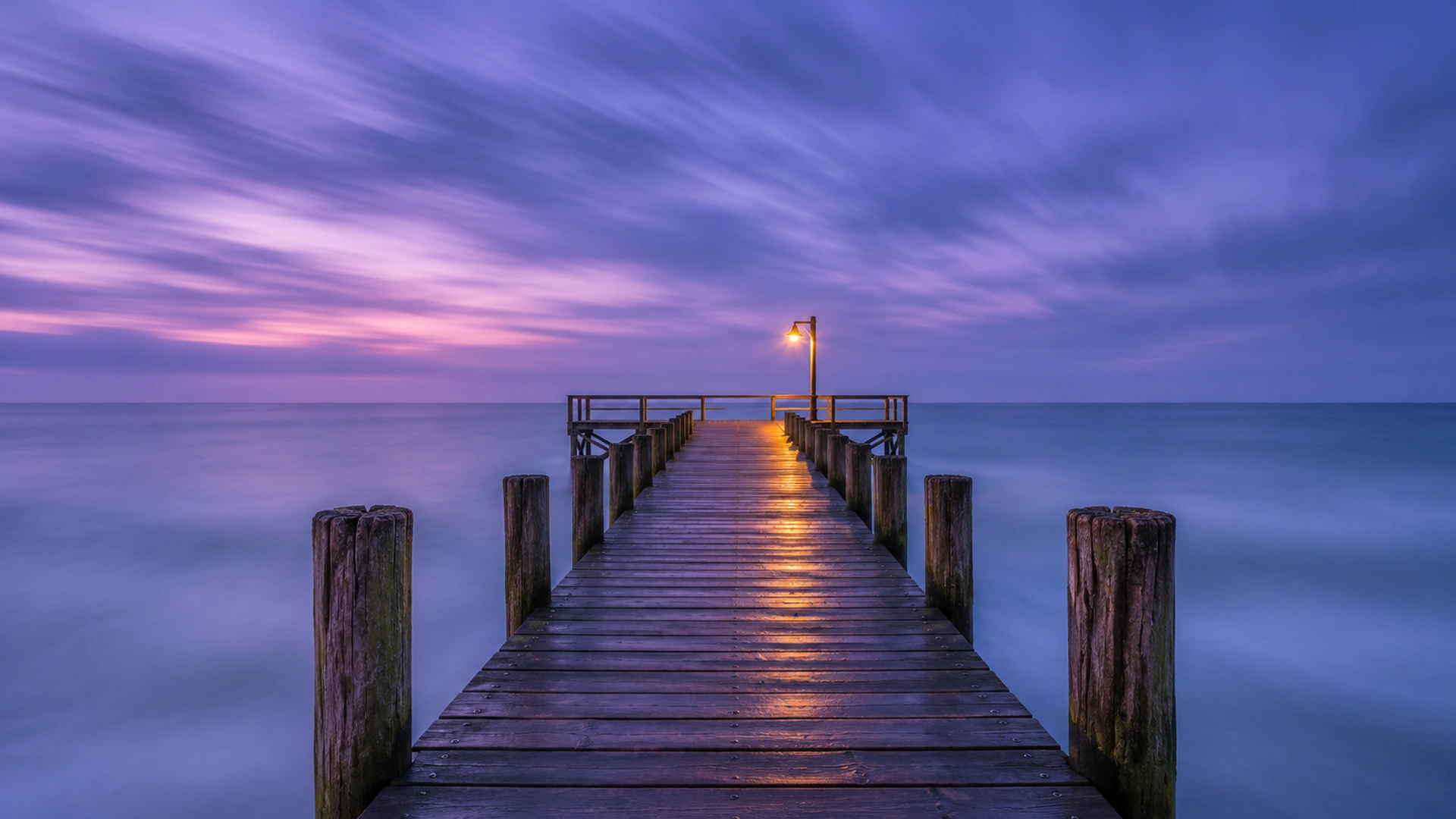
An original description inspired by the approach, not a copy: a black-and-white photograph of a calm sea at dawn, the horizon cutting the frame exactly in half, soft grey water with no visible waves after a long exposure, a pale silvery sky, no boats, no land, total stillness.
What to learn from Hiroshi Sugimoto
- Fix one rule, a horizon in the exact middle, and repeat it.
- Use time: describe how long the exposure is and what it erases.
- Keep the tones soft and the composition frontal.
Questions about Hiroshi Sugimoto
Who is Hiroshi Sugimoto?
Japanese photographer who uses long exposures and an old large-format camera to photograph time itself: identical horizons over the sea, cinemas lit by a whole film, and blurred buildings.
How do you recognize Hiroshi Sugimoto's work?
Strict centred compositions and calm symmetry. Long exposures that erase movement or burn a light source white. Series that repeat one subject with tiny variations.
How do you describe Hiroshi Sugimoto in words or a prompt?
Fix one rule, a horizon in the exact middle, and repeat it. Use time: describe how long the exposure is and what it erases. Keep the tones soft and the composition frontal.
Describe a series of five photographs of the same view near you, taken at five different times of day, all with the horizon or a central line in exactly the same place. What changes, and what stays?