A green sky and a wine-dark sea
In the Iliad and the Odyssey the sea is often 'wine-dark'. In 1858 the British statesman and classicist William Gladstone noticed something odd: Homer describes many colors, but nothing in the text is clearly blue, not even the sky. A few decades later the philologist Lazarus Geiger looked at ancient texts in other languages and found a similar pattern: blue seemed to arrive late.
Persian poetry offers its own surprise. Hafez writes: «مزرع سبز فلک دیدم و داس مه نو», 'I saw the green field of the sky and the sickle of the new moon.' The sky is green. Poets also called it کبود, مینا or فیروزهگون. These are not mistakes; they show that color words draw borders in different places, and that poets choose words for meaning as much as for hue.
Why blue comes late
In 1969 the anthropologist Brent Berlin and the linguist Paul Kay compared color terms across many languages and proposed a striking order. Languages with few basic color words tend to name dark and light first, then red, then green and yellow, and only later blue, followed by brown and then purple, pink, orange and grey. Their model has been debated and refined, but the late arrival of a separate word for blue has held up in many studies.
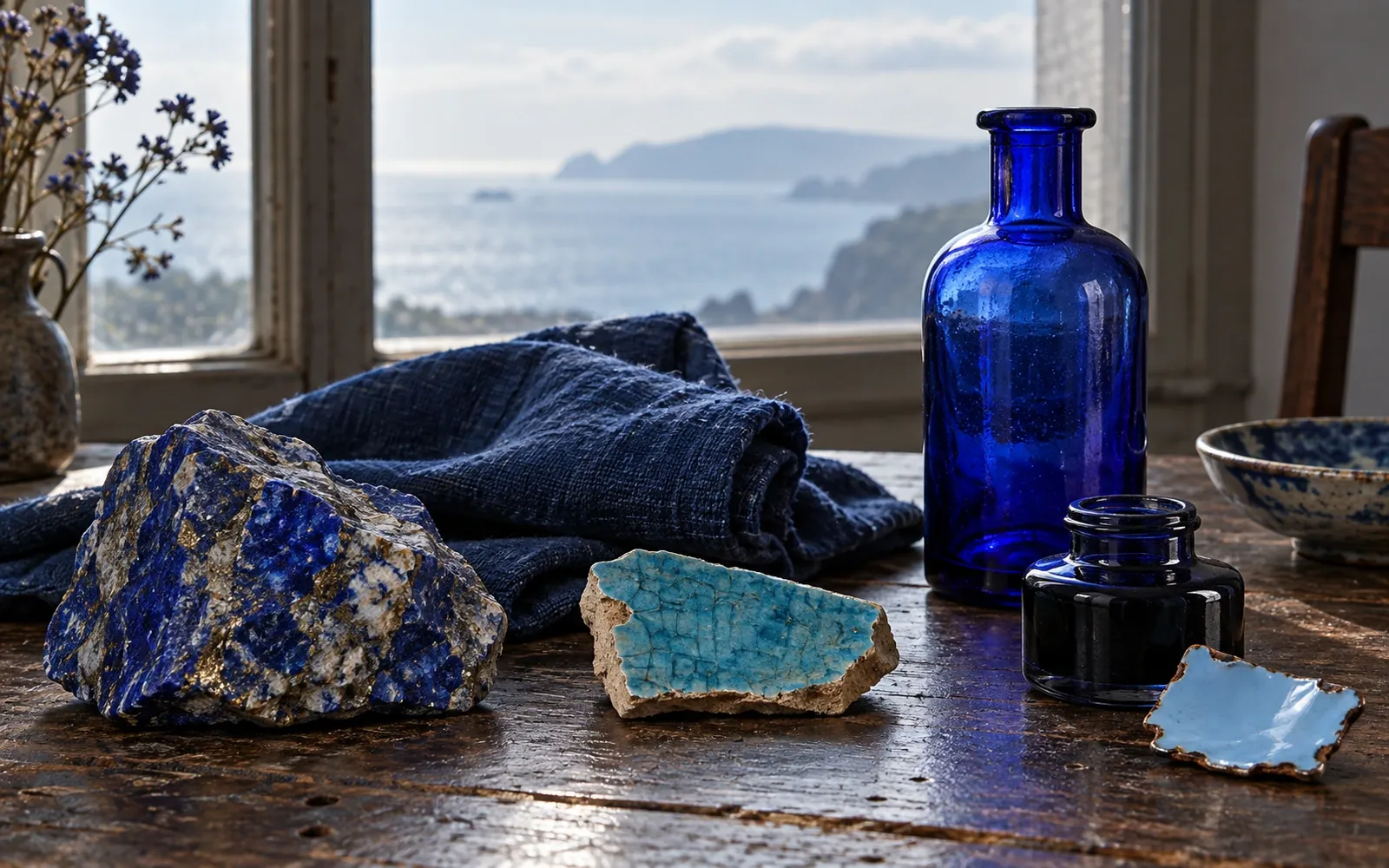
One reason may be that blue is rare where it matters. The sky and the sea are blue, but they are not things you can hold. Few plants and animals are truly blue, and many that look blue use structural color, tiny structures that scatter light, rather than blue pigment. Blue pigments were hard to make: Egyptian blue was a manufactured compound; ultramarine came from lapis lazuli mined in Badakhshan; indigo had to be extracted and fermented from plants. What is hard to make, trade and point at may also be slower to get its own name.
Do words change what we see?
The idea that language shapes thought is often called the Sapir–Whorf hypothesis. Its strong version, that language determines what we can perceive, is not supported: people can see differences they have no words for. Its weak version, linguistic relativity, says that language influences how quickly and easily we notice, remember and sort things, and this has real evidence.
Russian, for example, has two basic words where English has one: синий (siniy, darker blue) and голубой (goluboy, lighter blue). In a 2007 study led by Jonathan Winawer, with Lera Boroditsky among the authors, Russian speakers were faster at telling two blues apart when they fell on different sides of that boundary. The advantage disappeared when they had to do a verbal task at the same time, which suggests that words were helping in the moment.
In Japanese, 青 (ao) historically covered both blue and green, which is why green traffic lights are still called 'ao'. A popular online story claims that the Himba people of Namibia 'cannot see blue'. That is an exaggeration: research with Himba speakers shows that their color categories divide blues and greens differently from English, and that this affects some discrimination tasks, not that they are blind to a color.
The Persian blues
Persian has an unusually rich family of blues, and many of them carry a material story: a stone, a plant, a cosmetic, a glaze.
From آب, water: the everyday word for blue is literally 'watery'.
An older word for dark blue or grey-blue, used for the sky in poetry ('the blue wheel') and for bruises.
From نیل, indigo, a word that goes back to Sanskrit nīla, dark blue.
From lapis lazuli. The Persian lâzhvard passed through Arabic and Latin into European languages; English 'azure' comes from it.
Turquoise, the stone long mined near Nishapur, and the color of many domes and tiles.
Navy blue, named after kohl (سرمه), the dark eye cosmetic.
From مینا, enamel or glass; 'the enamel dome' is a poetic name for the sky.
Sky-colored, a light, clear blue.
The words to describe it
Precise words for the qualities above. Combine a few of them instead of naming the style or artist alone.
- deep lapis blue
- watery pale blue
- indigo dye blue
- turquoise tile
- navy kohl blue
- enamel sky blue
- bruised grey-blue
- electric blue
- ultramarine pigment
- structural blue sheen
What this means for describing images
- Having more words for a color does not give you new eyes, but it makes differences easier to notice, hold and share.
- Material words such as lapis, turquoise, indigo or kohl carry texture and history as well as hue.
- When you describe an image, try to name which blue: deep, watery, enamel-like, bruised, electric.
Where people get it wrong
'Ancient people could not see blue' is a myth. The evidence is about naming and attention, not eyesight. The more interesting truth is that the borders between colors are partly drawn by language, culture and the materials people lived with.
Collect ten blue things around you: a pen, a tile, a shirt, a screen, the sky. For each, write one word that is more precise than 'blue', borrowing from materials (ink, lapis, denim, glass) or feelings. Notice which blues were hard to tell apart before you named them.
Sources and further reading
- William Gladstone, Studies on Homer and the Homeric Age (1858).
- Brent Berlin and Paul Kay, Basic Color Terms: Their Universality and Evolution (1969).
- Jonathan Winawer, Nathan Witthoft, Michael C. Frank, Lisa Wu, Alex R. Wade and Lera Boroditsky, 'Russian blues reveal effects of language on color discrimination', PNAS (2007).
- Guy Deutscher, Through the Language Glass: Why the World Looks Different in Other Languages (2010).
- Kassia St Clair, The Secret Lives of Colour (2016).