Against the machine
The movement grew in Britain from the 1860s as a reaction to cheap, machine-made goods of the industrial age. Its thinking came from the critic John Ruskin, who argued in 'The Nature of Gothic' (1853) that good work needs a free, thinking maker, and its practice from William Morris, who founded the firm that became Morris & Co. in 1861 to make furniture, textiles, wallpaper and stained glass.
The name comes from the Arts and Crafts Exhibition Society, founded in London in 1887. The ideas spread to Glasgow, where Charles Rennie Mackintosh worked, to Vienna, and to the United States, where Gustav Stickley's Craftsman furniture and the Roycroft workshops made the style popular. Its idea that design is a moral question shaped the Bauhaus a generation later.
Visual anatomy of Arts and Crafts
Dense, flat patterns of leaves, flowers, birds and vines, drawn from English hedgerows and gardens.
Oak, copper, hand-thrown ceramics, wool, linen, vegetable dyes, handmade paper.
Visible joints, pegs and hinges: the way a thing is made is part of its beauty.
Earthy and natural: indigo, madder red, olive, ochre, cream.
Firm, rhythmic outlines, simpler and straighter than the whiplash of Art Nouveau.
Cottages and houses with inglenooks, built-in benches, leaded windows and gardens.
Words around Arts and Crafts
Letting wood look like wood and showing how things are made.
William Morris's firm, famous for wallpapers and textiles such as Strawberry Thief (1883).
Morris's private press, founded in 1891, which revived hand-printed books.
The American version: plain, solid oak furniture and bungalows.
How to recognize Arts and Crafts
- Flat, repeating patterns of plants and birds.
- Solid, plain furniture with visible joinery.
- Natural, earthy colours.
- Handmade marks: hammered metal, hand-printed paper, uneven glaze.
- Nature stylised, not copied photographically.
Where people get it wrong
Arts and Crafts is often confused with Art Nouveau. They share a love of nature and craft, but Arts and Crafts is sturdier and more rectilinear, with honest construction, while Art Nouveau is fluid, curving and often luxurious. Another mistake is to call any 'rustic' style Arts and Crafts; the movement was precise and highly designed.
Words to describe Arts and Crafts
Precise words for the qualities above. Combine a few of them instead of naming the style or artist alone.
- Arts and Crafts
- William Morris
- John Ruskin
- truth to materials
- joinery
- hand-block printing
- vegetable dye
- inglenook
- Craftsman
- repeat pattern
- Kelmscott
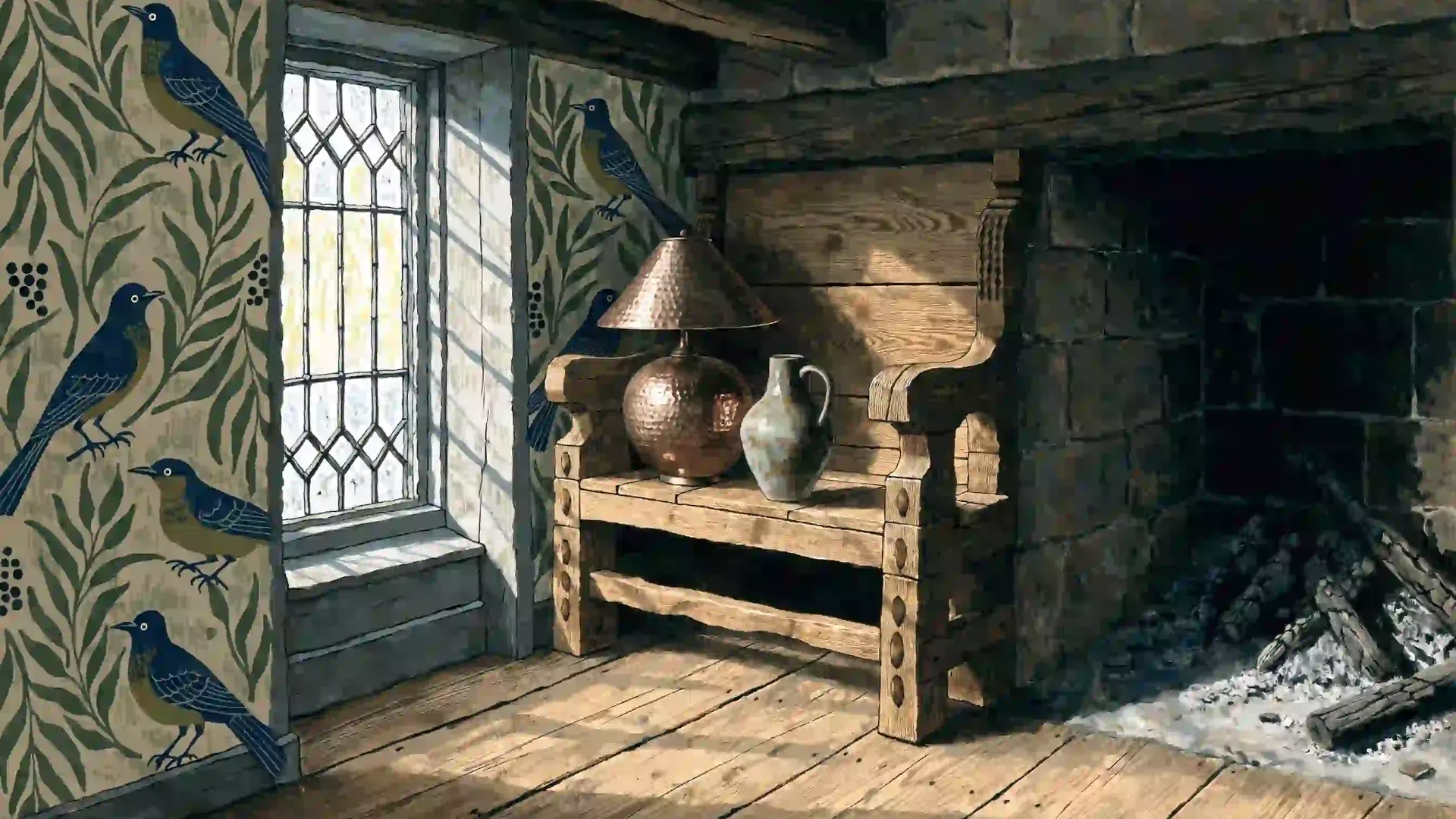
A study in the Arts and Crafts manner: oak bench with pegged joints, a hand-printed wallpaper of willow leaves and thrushes in indigo and olive, a hammered copper lamp, morning light through leaded glass.
What to take from Arts and Crafts today
- Name the material and how it was made.
- Describe the pattern's plants and how they repeat.
- Use earthy, dyed colours.
- Show the joinery or the hand's mark.
Making as meaning
Ruskin and Morris believed you could read a society in its objects: whether the maker was free or not shows in the work. It is an early version of a question Gen AI now asks again: what does it mean when a thing has no maker's hand in it? Describing an Arts and Crafts object well means naming the hand, the joint, the dye, the evidence that someone chose.
Questions about Arts and Crafts
What is the Arts and Crafts movement?
A design movement that began in Britain around the 1860s, led by William Morris and inspired by John Ruskin, which promoted handmade, well-built objects and nature-based patterns against industrial mass production.
What are the characteristics of Arts and Crafts style?
Flat nature patterns, solid furniture with visible joinery, natural materials such as oak and copper, earthy colours, and visible handcraft.
What is the difference between Arts and Crafts and Art Nouveau?
Both draw on nature, but Arts and Crafts is sturdy, straight-lined and focused on honest making, while Art Nouveau is curving, fluid and more decorative.
Describe a wooden chair you know as an Arts and Crafts designer would: the wood, every joint you can see, how it was finished, and what in it shows that a person made it.
Sources and further reading
- William Morris Gallery, London: collection and history.
- Victoria and Albert Museum: Arts and Crafts movement.
- John Ruskin, 'The Nature of Gothic', in The Stones of Venice, vol. 2, 1853.
- Rosalind P. Blakesley, The Arts and Crafts Movement, Phaidon, 2006.