An imagined Cathay
From the 17th century, Chinese porcelain, silk, lacquer and painted wallpaper reached Europe through trade, and they were costly and admired. European makers began to imitate them and then to invent their own 'Chinese' scenes, mixing Chinese, Japanese and Indian motifs with pure fantasy. The style peaked in the 18th century alongside the Rococo.
Examples range from Delftware and Meissen porcelain to William Chambers's Great Pagoda at Kew (1762) and the Royal Pavilion in Brighton (remodelled by John Nash, 1815–1823). The 'Willow pattern', a blue-and-white design invented in England in the late 18th century, came with a made-up Chinese love story. Today the style is admired as decoration and examined as a form of Orientalism: a Western image of the East that had little to do with China itself.
Visual anatomy of Chinoiserie
Pagodas, bridges, willows, cranes, peonies, birds on branches, figures in pavilions.
Blue and white; also red and gold lacquer, soft greens and pinks on silk.
Porcelain, lacquer, painted wallpaper, silk, embroidered panels.
Asymmetric scenes floating on plain grounds, little perspective.
Delicate, curling and decorative, close to the Rococo.
Exotic fantasy, luxury, playfulness.
Words around Chinoiserie
An old European name for China, used for an imagined, fairy-tale East.
An English blue-and-white transfer-printed design from the late 18th century.
European imitation of Asian lacquer.
Edward Said's term for the West's constructed images of the East.
How to recognize Chinoiserie
- Fantasy East Asian scenes on European objects.
- Pagodas, bridges, willows and birds.
- Blue and white or lacquer colours.
- Light, asymmetric decoration close to the Rococo.
Where people get it wrong
Chinoiserie is often taken to be Chinese art. It is European art about an imagined China, usually mixing sources from across Asia. Calling it authentic erases both real Chinese art and the colonial trade it grew from. It is also worth separating historical chinoiserie from Chinese export art, which was made in China for European buyers.
Words to describe Chinoiserie
Precise words for the qualities above. Combine a few of them instead of naming the style or artist alone.
- chinoiserie
- Cathay
- porcelain
- blue and white
- Willow pattern
- japanning
- lacquer
- pagoda
- export art
- Orientalism
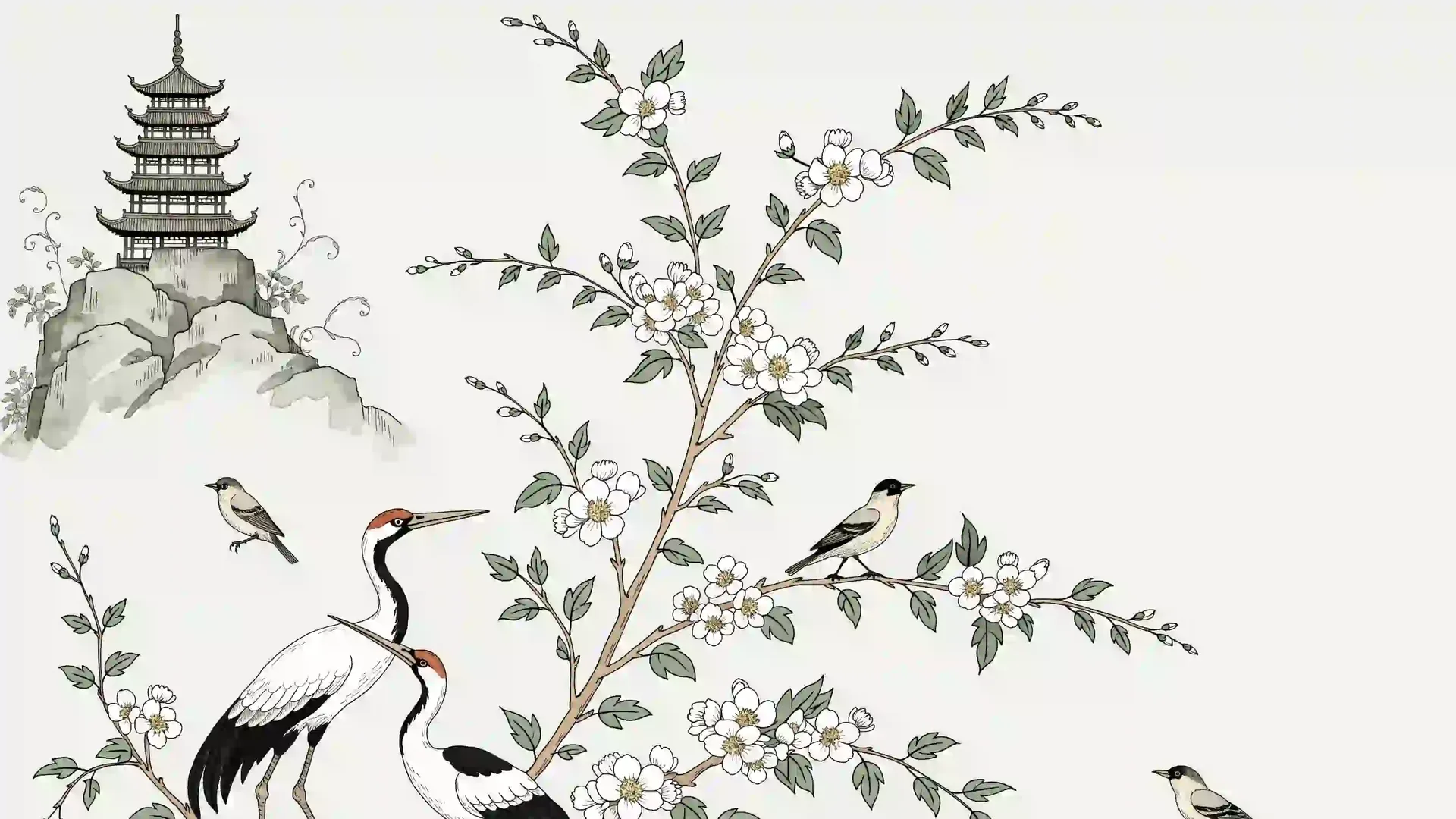
A chinoiserie wallpaper study: a pale celadon ground with a flowering branch rising across it, two cranes and small songbirds, a distant pagoda on a rock, delicate line, asymmetric and airy.
What to take from Chinoiserie today
- Name the motifs: pagoda, willow, crane, branch.
- Say the material: porcelain, lacquer, painted paper.
- Describe it as a European fantasy, not as Chinese art.
- Keep the decoration light and asymmetric.
Whose story is the picture?
Chinoiserie is a picture of China told entirely by others. It is a good example of how an aesthetic can carry a story about people who never had a say in it. When you describe or generate this style, naming it as a European fantasy is part of describing it accurately.
Questions about Chinoiserie
What is chinoiserie?
A European decorative style, at its height in the 17th and 18th centuries, that imitated and imagined Chinese and East Asian art, seen in porcelain, wallpaper, lacquer, textiles and garden buildings.
What is chinoiserie wallpaper?
Wallpaper with painted or printed East Asian-inspired scenes, often birds and flowering branches. Some historic examples were hand-painted in China for export; many later ones are European imitations.
Is chinoiserie offensive?
It is debated. Many value it as decorative history, while scholars point out that it is a Western fantasy that often stereotyped China. Describing it clearly as European invention helps.
Find a chinoiserie object in a museum collection, such as a teacup or a wallpaper panel. Describe it, then list which motifs are Chinese in origin, which are from elsewhere in Asia, and which seem invented.
Sources and further reading
- Hugh Honour, Chinoiserie: The Vision of Cathay, John Murray, 1961.
- Victoria and Albert Museum: Chinoiserie and export art collections.
- Brighton & Hove Museums: Royal Pavilion.
- Edward W. Said, Orientalism, Pantheon Books, 1978.