Colour as the whole event
Color Field painting grew in the United States in the late 1940s and 1950s, alongside the more gestural side of Abstract Expressionism. Mark Rothko, Barnett Newman and Clyfford Still made huge canvases of colour areas, soft-edged rectangles, vertical 'zips' or jagged fields, meant to be seen up close so that colour fills the viewer's sight.
A second generation developed it in a cooler direction. Helen Frankenthaler's Mountains and Sea (1952) poured thinned paint into unprimed canvas, the 'soak-stain' technique, and Morris Louis and Kenneth Noland in Washington took it further. The critic Clement Greenberg championed this work, and his 1964 exhibition Post-Painterly Abstraction gave it another name.
Visual anatomy of Color Field Painting
Very large canvases, often taller than a person.
Broad areas of one colour or close colours, sometimes glowing, sometimes deep and dark.
Soft, feathered borders (Rothko), sharp vertical bands (Newman), or stained, bleeding edges (Frankenthaler, Louis).
Thin layers or stains with little visible brushwork.
Simple and often symmetrical; no focal point, no figure.
Meditative, immersive, physical; the colour seems to breathe or vibrate.
Words around Color Field
Pouring thinned paint onto raw canvas so it soaks into the weave.
Barnett Newman's name for the thin vertical bands in his paintings.
Greenberg's term for the cooler, flatter abstraction after the gestural painters.
A chapel in Houston, opened in 1971, holding fourteen dark Rothko paintings.
How to recognize Color Field Painting
- Huge canvases dominated by a few colours.
- No figures, no obvious brushwork.
- Soft, stained or sharply banded edges.
- A calm, immersive effect up close.
Where people get it wrong
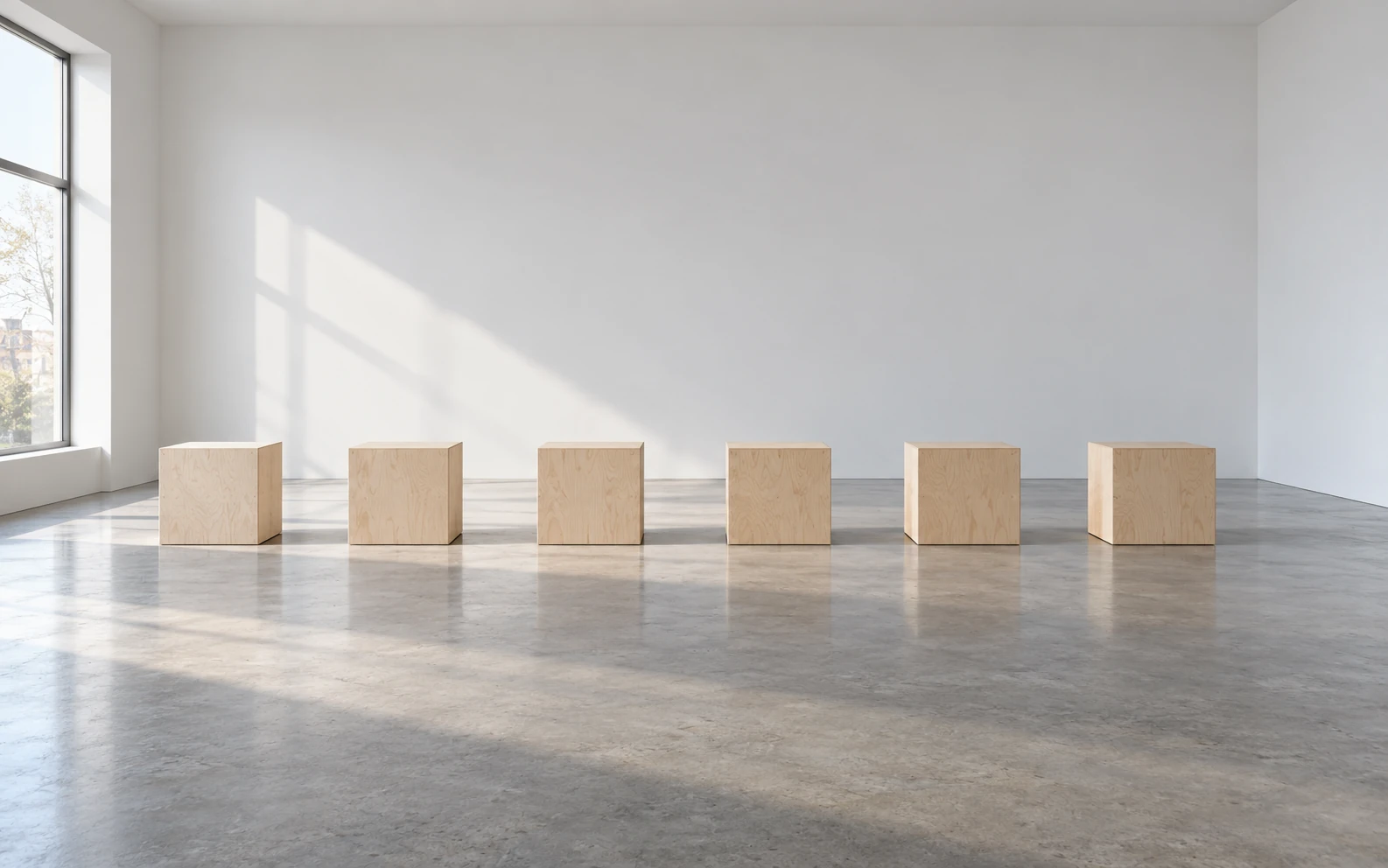
Color Field is often called 'just colour', as if anyone could do it. The effect depends on exact choices of scale, edge, thinness, layering and the relationship between neighbouring colours. Another mistake is to mix it up with Minimalism; Color Field is about colour's emotional and optical effect, while Minimalism is about objects and their presence in space.
Words to describe Color Field Painting
Precise words for the qualities above. Combine a few of them instead of naming the style or artist alone.
- Color Field
- soak-stain
- zip
- feathered edge
- unprimed canvas
- luminosity
- scale
- Post-Painterly Abstraction
- immersion
- chromatic
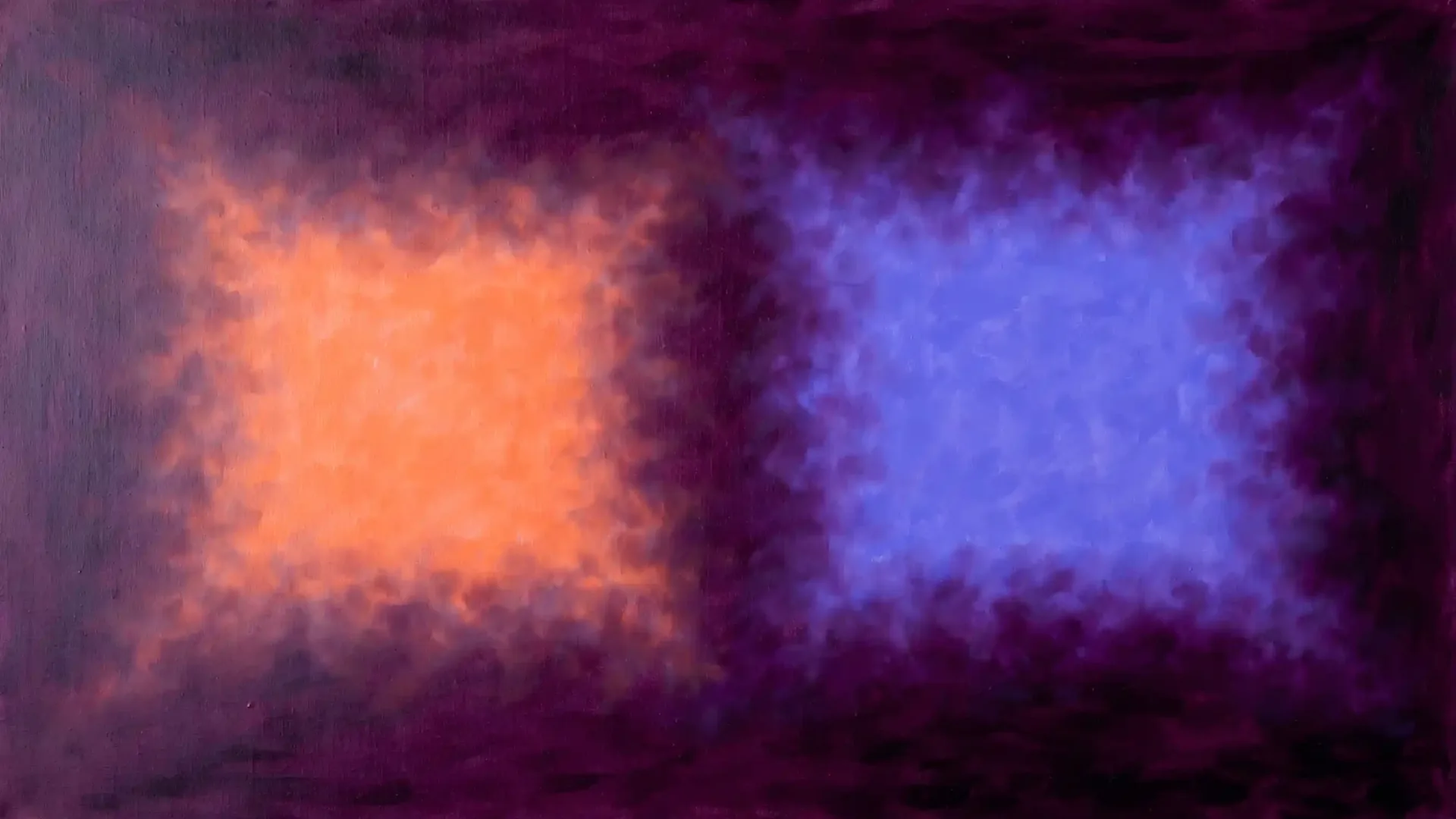
A colour field study: a tall canvas of deep plum, two soft-edged horizontal rectangles floating on it, one a glowing ember orange, one a dusk violet, their edges blurred as if breathing, thin layered paint.
What to take from Color Field Painting today
- Give the scale relative to a person.
- Name the colours and how their edges meet.
- Say whether the paint is stained, layered or flat.
- Describe the feeling of standing close to it.
The unsaid at full size
A Color Field painting removes nearly everything a description usually holds on to: object, figure, story. What remains is relation: this red against that maroon, this edge breathing into that one. It is a hard and useful exercise in thick description, because words must carry what is barely there.
Questions about Color Field Painting
What is Color Field painting?
A style of abstract painting that developed in the United States from the late 1940s, using large areas of flat or stained colour rather than gestures or figures, by artists such as Rothko, Newman, Still, Frankenthaler and Morris Louis.
How is Color Field different from Abstract Expressionism?
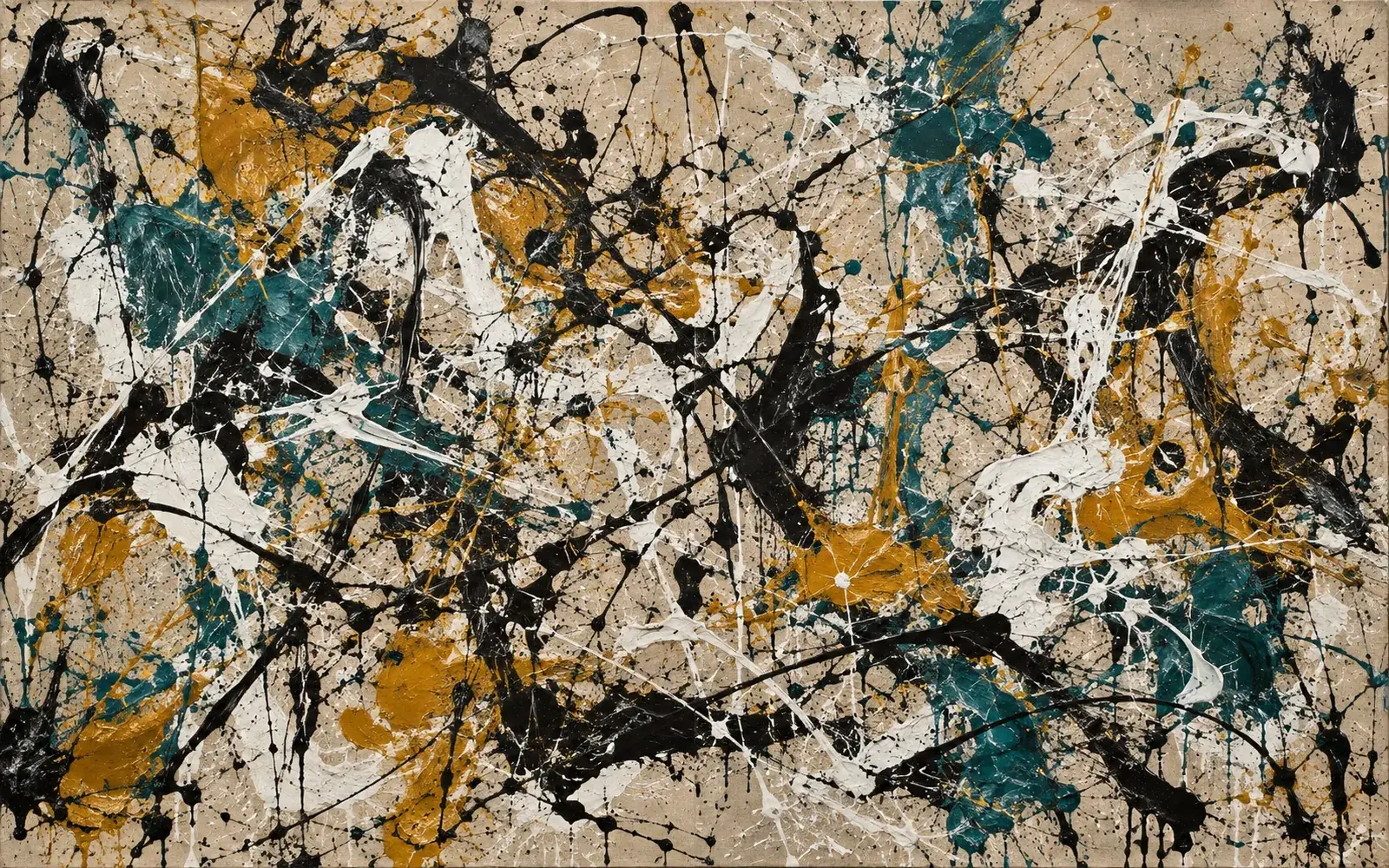
It is part of the wider Abstract Expressionist moment, but where action painters such as Pollock emphasised gesture and energy, Color Field painters focused on large, calm areas of colour.
What is the soak-stain technique?
Pouring thinned paint onto unprimed canvas so that it soaks into the fibres, creating soft, transparent areas of colour. Helen Frankenthaler pioneered it in 1952.
Find a Rothko painting in a museum's online collection. Describe it for a full minute without using the words red, blue or black. Use only temperature, depth, edge and how the colours seem to move.
Sources and further reading
- Museum of Modern Art, New York: Color Field painting.
- National Gallery of Art, Washington: Helen Frankenthaler, Mountains and Sea (on loan) and collection notes.
- Clement Greenberg, Post Painterly Abstraction, exhibition catalogue, Los Angeles County Museum of Art, 1964.
- The Rothko Chapel, Houston.