The ideal body
Ancient Greek art runs from the Geometric period (around 900–700 BCE), with pottery covered in bands of patterns, through the Archaic period, with stiff standing youths (kouroi) and their 'archaic smile', to the Classical period of the 5th and 4th centuries BCE, when Athens built the Parthenon (447–432 BCE) and sculptors such as Polykleitos defined rules of ideal proportion.
In the Hellenistic period after Alexander the Great, sculpture became more dramatic and emotional, as in the Winged Victory of Samothrace. Rome copied Greek works endlessly, and the Renaissance, Neoclassicism and even today's vaporwave busts all look back to them. One surprise: the white marble we know was originally painted in bright colours.
Visual anatomy of Greek Art
Idealised human figures with balanced proportions, often nude athletes and gods.
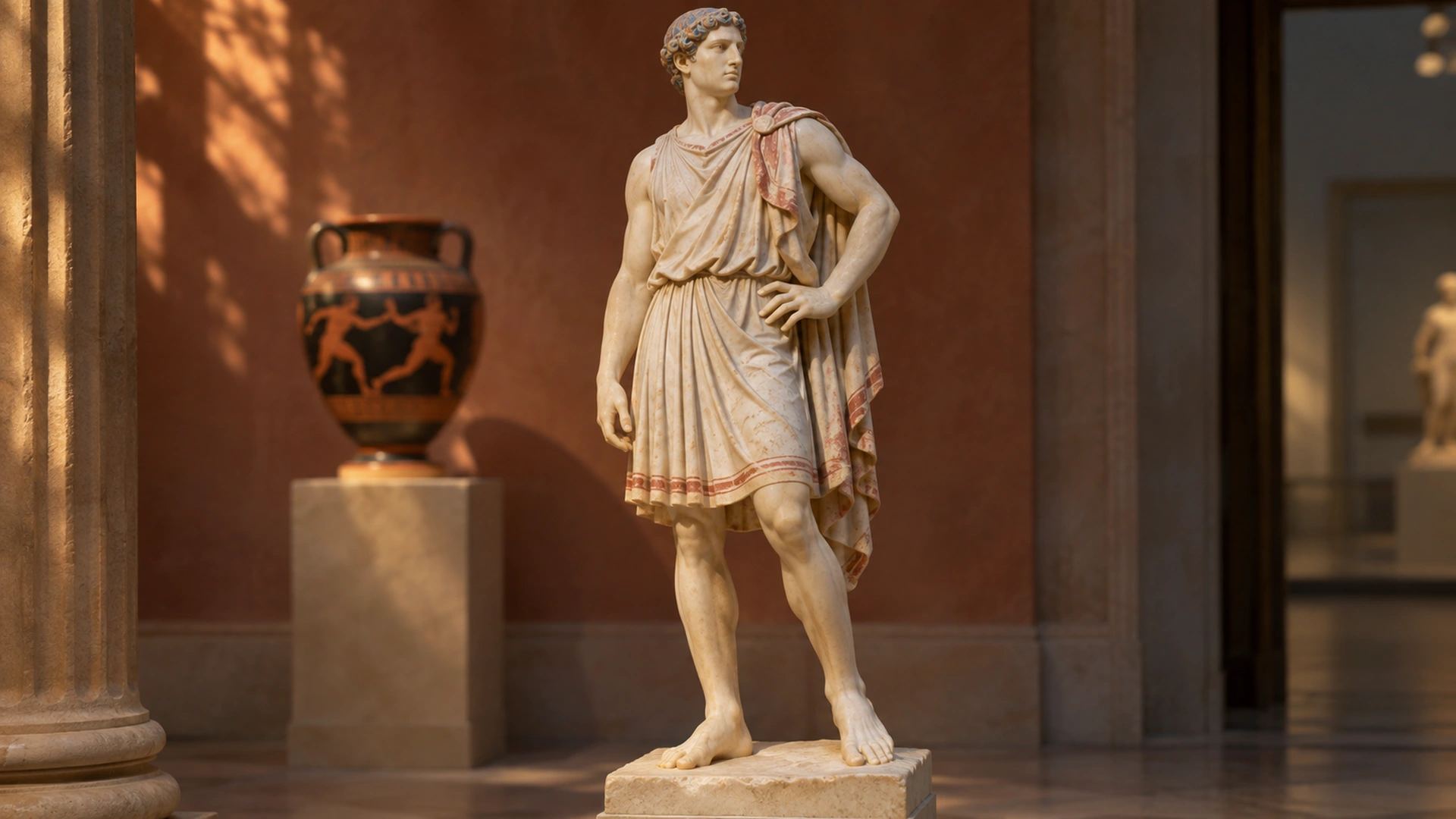
Weight on one leg, hips and shoulders tilted: the relaxed, living stance of Classical statues.
Thin cloth carved so it clings to the body in flowing folds ('wet drapery').
Black-figure (black figures on red clay) and later red-figure (red figures on black), with bands of meander pattern.
Columns in the Doric, Ionic and Corinthian orders, pediments, friezes and harmonious proportions.
Originally painted sculpture and buildings; the white we see is what survived.
Periods
Vases covered in bands of meanders and stick-like figures.
Stiff frontal statues, the 'archaic smile', black-figure pottery.
Calm idealised bodies, contrapposto, the Parthenon.
Drama, movement, emotion and realistic old age and pain.
How to recognize Greek Art
- Idealised marble or bronze bodies in balanced poses.
- Black-figure or red-figure painted vases.
- Columns, pediments and the meander (Greek key) pattern.
Where people get it wrong
The pure white marble we associate with Greece is a later idea. Traces of paint show that statues and temples were brightly coloured. Treating 'Greek' as only white, calm and perfect also forgets the dramatic, emotional Hellenistic period.
Words to describe Greek Art
Precise words for the qualities above. Combine a few of them instead of naming the style or artist alone.
- classical Greek marble statue
- contrapposto pose
- wet drapery folds
- red-figure vase painting
- black-figure pottery
- meander Greek key border
- Doric columns
- idealised proportions
- Hellenistic drama
- original painted polychromy
An original study of a classical Greek marble statue in a museum: a young athlete in contrapposto, weight on one leg, thin drapery clinging to one shoulder, warm side light showing the smooth marble, faint traces of original blue and red paint on the hair and cloth.
What to take from Greek Art today
- Name the period: Archaic, Classical, Hellenistic.
- Describe the pose and the drapery.
- Say the material and surface: marble, bronze, painted clay.
Questions about Greek Art
What is Greek Art?
The art of ancient Greece: painted pottery, marble gods and athletes, temples of perfect proportion, and the ideal human body that Europe copied for centuries.
How do you recognize Greek Art?
Idealised marble or bronze bodies in balanced poses. Black-figure or red-figure painted vases. Columns, pediments and the meander (Greek key) pattern.
How do you describe Greek Art in words or a prompt?
Name the period: Archaic, Classical, Hellenistic. Describe the pose and the drapery. Say the material and surface: marble, bronze, painted clay.
Stand with your weight on one leg and notice how your hips and shoulders tilt. Describe that pose as if you were describing a Classical statue, and then the same body in a stiff Archaic pose.