Out of the white cube
Land Art developed in the late 1960s, mainly in the United States and Britain, as artists looked for ways to make work that could not be bought, moved or hung on a wall. The exhibition 'Earthworks' at the Dwan Gallery in New York in 1968 gave the movement one of its names.
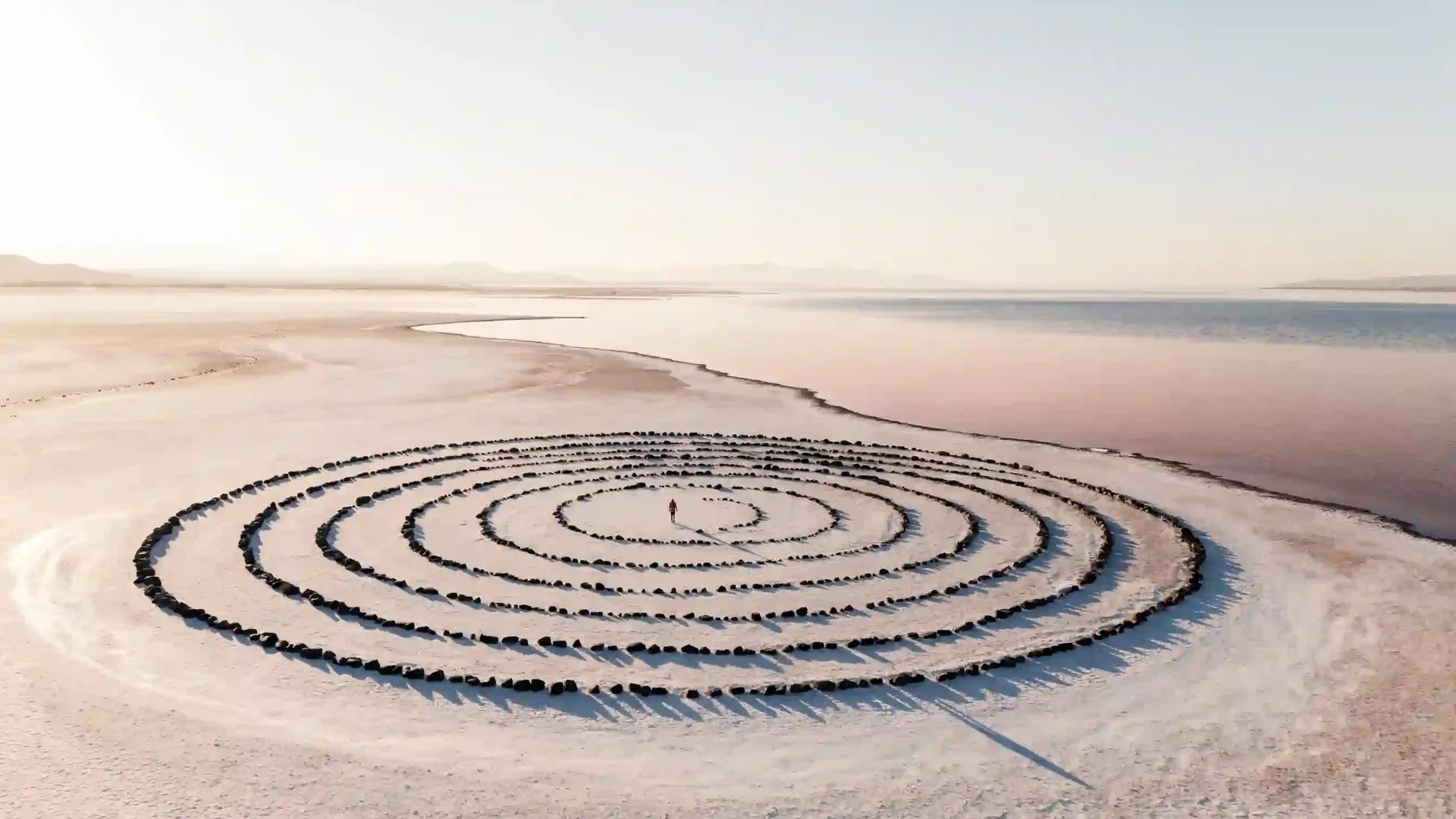
Robert Smithson built Spiral Jetty (1970), a coil of black basalt rock in the Great Salt Lake, Utah. Michael Heizer cut Double Negative (1969–70) into a Nevada mesa. Walter De Maria installed The Lightning Field (1977), 400 steel poles in New Mexico, and Nancy Holt made Sun Tunnels (1973–76) in the Utah desert, aligned with the solstices. In England, Richard Long made A Line Made by Walking (1967) by walking back and forth across a field and photographing the trace.
Visual anatomy of Land Art
Remote deserts, lakes, fields and coasts; the place is part of the work.
Earth, rock, water, salt, light, sometimes steel or concrete.
Monumental, or tiny and temporary, like a line of stones or a path in grass.
Weather, erosion, seasons and the sun change or erase the work.
Often known through aerial photographs, film and maps more than by visiting.
Silent, vast, geological, ritual.
Words around Land Art
A large work made by moving earth and rock.
Made for one place and meaningless if moved.
Smithson's interest in decay and disorder over time.
Smithson's gallery pieces of rocks and maps that point to a distant site.
How to recognize Land Art
- The work is the landscape itself, shaped or marked.
- Natural materials on a large or very quiet scale.
- Often seen in aerial photographs.
- Lines, spirals, circles and alignments with the sun.
Where people get it wrong
Land Art is often confused with landscape painting or with garden design. It is neither a picture of nature nor decoration of it; it uses the land as material and place. It is also not automatically ecological: some early earthworks moved thousands of tons of rock with bulldozers.
Words to describe Land Art
Precise words for the qualities above. Combine a few of them instead of naming the style or artist alone.
- Land Art
- earthwork
- site-specific
- entropy
- non-site
- aerial view
- alignment
- ephemeral
- basalt
- Dia Art Foundation
A Land Art study: a spiral of dark stones laid on pale salt flats at the edge of pink water, seen from a drone at dawn, one person standing at the centre for scale, long shadows.
What to take from Land Art today
- Name the site and the material.
- Give the scale against a human figure or a vehicle.
- Describe the view: aerial, ground level or both.
- Add time: light, weather, erosion.
A sentence written on the ground
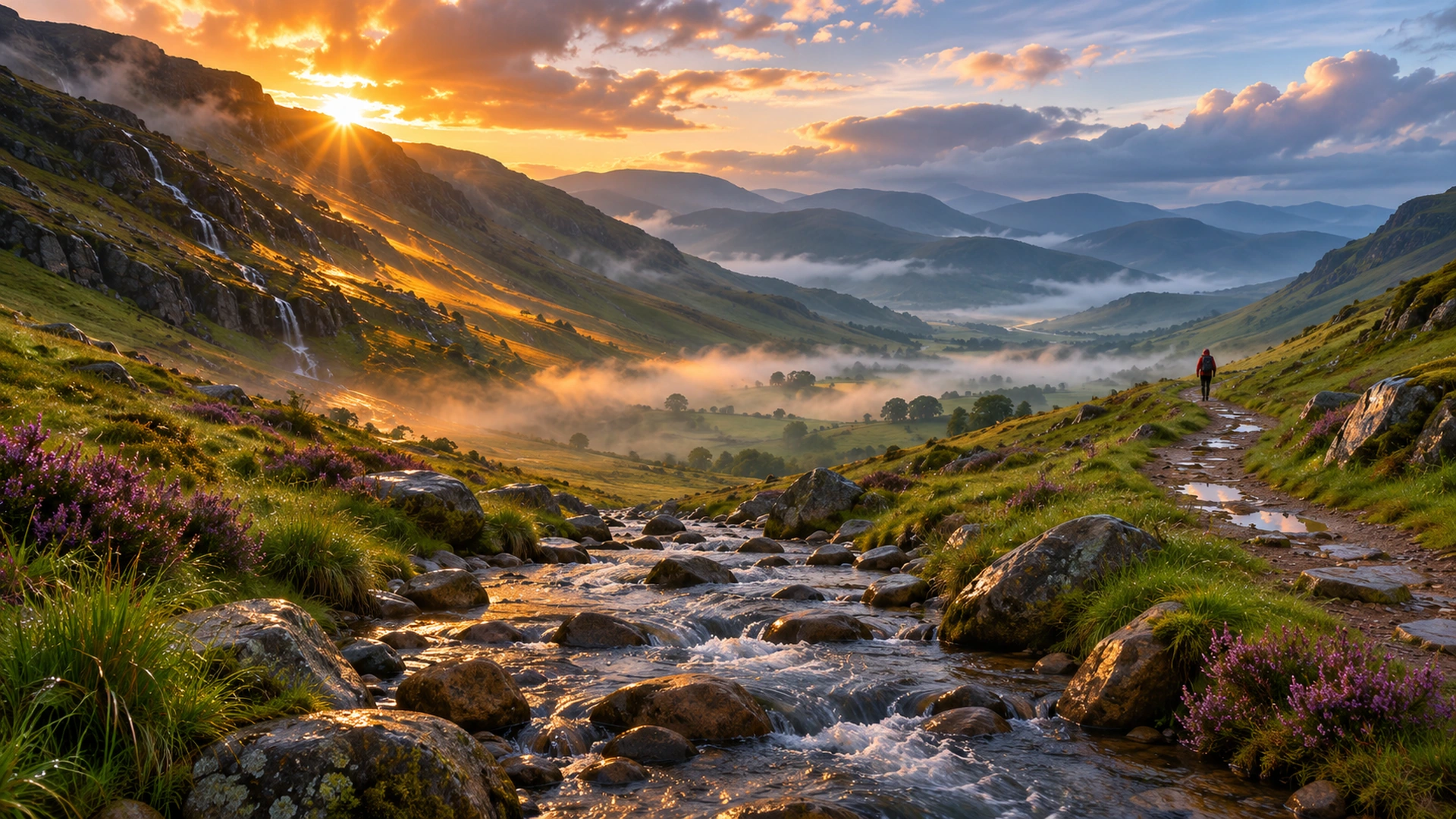
Richard Long's line in the grass is a kind of writing: a mark that says 'someone was here, walking'. Much Land Art is closer to a poem than to a monument, a gesture that the weather will edit. Describing it well means describing what is absent too: the walker, the time, the parts already gone.
Questions about Land Art
What is Land Art?
An art movement from the late 1960s in which artists made works in the landscape using natural materials such as earth, rock and water, often on a large scale and far from galleries.
What are famous examples of Land Art?
Robert Smithson's Spiral Jetty (1970), Michael Heizer's Double Negative (1969–70), Walter De Maria's The Lightning Field (1977), Nancy Holt's Sun Tunnels (1973–76) and Richard Long's A Line Made by Walking (1967).
Can you visit Spiral Jetty?
Yes. It is on the north-east shore of the Great Salt Lake in Utah and is cared for by the Dia Art Foundation. Depending on the water level, it can be submerged or fully exposed.
Make a small piece of land art in a park or on a beach using only what is already there: stones, leaves, sticks, sand. Photograph it from directly above and from ground level, then describe how the two views change what it is.
Sources and further reading
- Dia Art Foundation: Robert Smithson, Spiral Jetty; Walter De Maria, The Lightning Field.
- Suzaan Boettger, Earthworks: Art and the Landscape of the Sixties, University of California Press, 2002.
- Holt/Smithson Foundation: Nancy Holt, Sun Tunnels.
- Tate: Richard Long, A Line Made by Walking.