From limitation to style
In 3D graphics every surface is made of polygons, usually triangles. In the 1990s computers and consoles could draw only a few hundred or thousand per frame, so characters in games like Virtua Fighter (1993) or on the first PlayStation had blocky heads and angular limbs. That was a limit, not a choice.
As hardware improved and models became smooth, artists began choosing low polygon counts on purpose. In the 2010s indie games such as Superhot and countless mobile titles used flat-shaded facets with soft pastel lighting. Illustrators made 'polygon art' by triangulating photographs into faceted mosaics.
Today low poly has two main moods. One is clean and calm: pastel or gradient colours, flat shading, soft shadows, miniature landscapes. The other is nostalgic: the 'PS1 aesthetic', with jittering vertices, warped low-resolution textures and fog, used in indie horror and music videos.
Visual anatomy of Low Poly
Visible flat triangles or polygons; curved forms broken into planes.
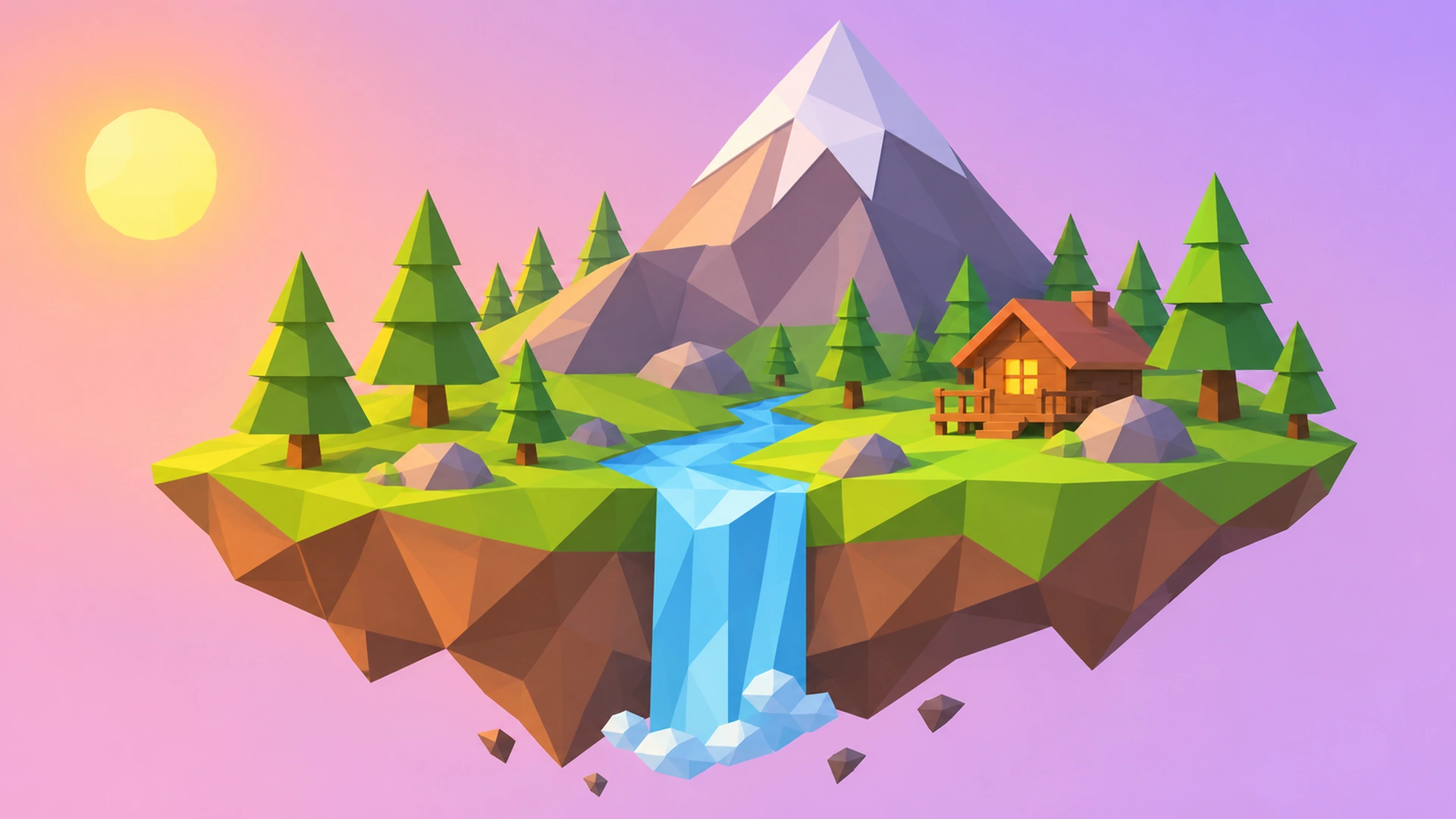
Flat shading: one colour per facet, so the light reads as steps rather than gradients.
Limited palettes, often pastel or gradient-based; colour changes facet by facet.
One soft directional light and gentle ambient occlusion; the facets do the modelling.
Often miniature: islands, trees as cones, mountains as pyramids, toy-like objects.
Usually none in the clean style; tiny, pixelated, warped textures in the PS1 style.
Words around low poly
The number of polygons in a model; low poly keeps it deliberately small.
Each face is lit as one colour, the opposite of smooth shading.
Breaking a surface or image into triangles.
The look of first-generation PlayStation 3D: low polygons, warped textures, vertex wobble.
How to recognize Low Poly
- Objects built from clearly visible flat facets.
- Light that changes in steps from facet to facet.
- Simple geometric trees, rocks and mountains.
- Limited, often pastel or gradient colour.
- A clean, toy-like or miniature feel, or a fuzzy 1990s game look.
Where people get it wrong
Low poly is not the same as unfinished or bad 3D. Good low poly is carefully designed: every facet is placed to describe a form with the fewest planes, like a sculptor roughing out stone. It is also not isometric art; low poly can use any camera, and isometric art need not be faceted.
Words to describe Low Poly
Precise words for the qualities above. Combine a few of them instead of naming the style or artist alone.
- low poly
- flat shading
- visible facets
- triangulated mesh
- pastel gradient palette
- geometric cone trees
- pyramid mountains
- floating island diorama
- soft directional light
- minimal 3D
- PS1 aesthetic
- vertex jitter
A low poly floating island diorama: flat-shaded triangular facets, cone-shaped pine trees, a pyramid mountain with a white faceted peak, a small waterfall made of blue planes, a soft pastel gradient sky from peach to lilac, one gentle sun from the left, clean minimal 3D render.
What to take from Low Poly today
- Say 'flat-shaded low poly', or you may get smooth 3D.
- Name the mood: clean pastel diorama or 1990s console look.
- Ask for simple geometric forms: cone trees, pyramid mountains.
- Specify the light: one soft sun, gentle shadows.
Questions about Low Poly
What does low poly mean?
Low polygon: a 3D model or image built from a small number of polygons, usually with the flat faces left visible. It began as a technical necessity in early 3D games and is now a deliberate style.
What is the PS1 aesthetic?
A nostalgic version of low poly based on first-generation PlayStation graphics: low polygon models, small blurry or warped textures, vertices that wobble, dithering and fog. It is popular in indie horror games and music videos.
Is low poly easier to make than realistic 3D?
It takes fewer polygons, but not less design. With so few planes, each one has to be placed exactly so the form still reads, and colour and light have to carry the mood.
Describe a familiar object, a mug, a fox or a mountain, as if you had only twelve flat faces to build it. Which facets would you keep? Write the colour of the three faces that catch the most light.
Sources and further reading
- Blender Manual: Shading, flat and smooth.
- Jesse Schell, The Art of Game Design, CRC Press, 2008.
- Timothy Reynolds, low poly illustration portfolio.
- Polycount Wiki: Low poly modelling.