Measured, not perspective
Isometric means 'equal measure'. In an isometric projection the three axes of an object, width, depth and height, are drawn at equal angles of 120 degrees to each other and shortened by the same amount. There are no vanishing points: parallel lines stay parallel, and objects do not get smaller with distance. That makes it ideal for showing how things are built and how they fit together, which is why engineers and architects used it long before illustrators did.
Video games made it popular: arcade games such as Zaxxon (1982) and Marble Madness (1984), and later city-builders such as SimCity 2000 (1993), used isometric views to suggest depth on flat screens. Pixel artists adopted a 2:1 line (two pixels across, one up), slightly flatter than true isometric, and the name stuck. Since the 2010s isometric illustration has become a favourite of tech companies, infographics and games such as Monument Valley (2014), which borrows M. C. Escher's impossible geometries.
Visual anatomy of isometric illustration
Viewed from above at a corner; floor lines run at about 30 degrees.
Parallel lines stay parallel; no vanishing points.
Objects keep their size wherever they are in the scene.
Clean blocks, cut-away rooms, tiles, stairs and platforms.
Flat or softly shaded faces: one tone for top, one for each side.
Floating islands, cross-sections and dioramas on a plain background.
Terms
Three axes at 120 degrees, equally foreshortened.
The flatter pixel-art version, often still called isometric.
The family of projections without vanishing points that includes isometric.
A building or room with walls removed to show the inside.
How to recognize isometric illustration
- A corner-on view from above.
- Parallel edges that never converge.
- Small detailed rooms or cities like dioramas.
- Flat colour with a light top and darker sides.
Where people get it wrong
Asking for 'isometric' and getting a normal 3D render with perspective. Isometric is a specific projection: name the corner view, the absence of vanishing points and the equal scale. Without those words, models often drift back to perspective.
Words to describe isometric illustration
Precise words for the qualities above. Combine a few of them instead of naming the style or artist alone.
- isometric illustration
- isometric view
- no vanishing points
- parallel lines
- corner-on overhead angle
- diorama
- cutaway room
- flat shading
- 2:1 pixel line
- axonometric projection
- floating island
- clean blocky forms
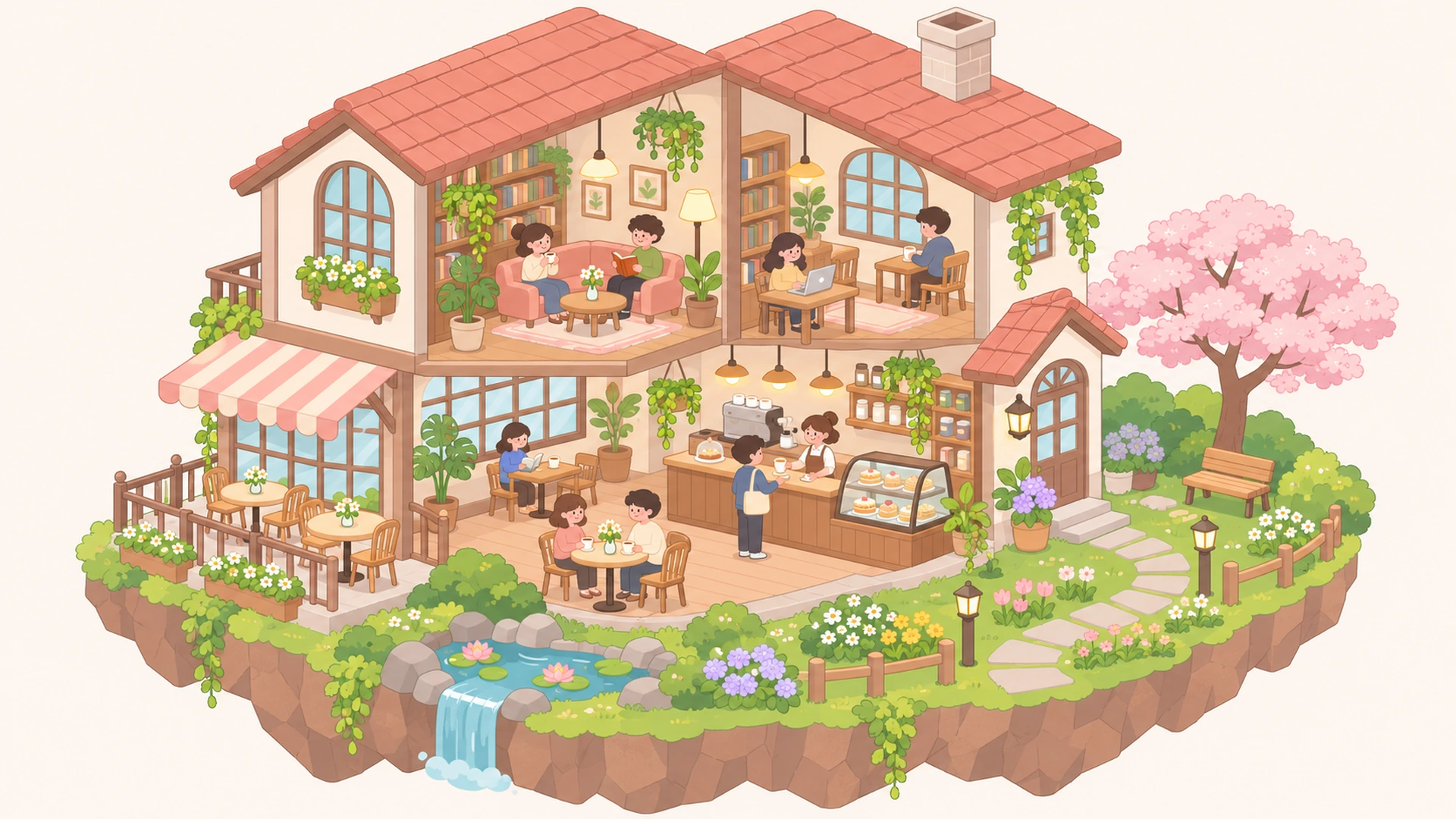
An original isometric illustration study: a tiny floating island with a two-storey café cut away to show its rooms, a counter, plants and people inside, a small garden and a winding path, isometric view with no perspective, flat soft shading, pastel palette, plain light background.
What to take from isometric illustration today
- Say 'isometric view, no perspective, parallel lines'.
- Describe it as a diorama or cutaway on a plain background.
- Use flat shading: light top, mid and dark sides.
- Keep objects simple and blocky, with small details.
Questions about isometric illustration
What does isometric mean in illustration?
Drawing 3D objects with three equal axes at 120 degrees and no vanishing points, so parallel lines stay parallel and size doesn't shrink with distance.
What is the difference between isometric and perspective?
Perspective makes lines converge toward vanishing points and things smaller with distance. Isometric keeps lines parallel and sizes equal.
Describe your own room as an isometric cutaway diorama: which two walls are removed, what sits in each corner, and the three tones for the top and sides of the furniture.
Sources and further reading
- William Farish, 'On Isometrical Perspective', Transactions of the Cambridge Philosophical Society (1822).
- Ingrid Carlbom and Joseph Paciorek, 'Planar Geometric Projections and Viewing Transformations', ACM Computing Surveys (1978).