Style about style
Mannerism describes art made in Italy from about 1520 to 1600, between the High Renaissance and the Baroque. The name comes from the Italian maniera, 'style' or 'manner', a word the painter and biographer Giorgio Vasari used as praise for graceful, sophisticated work. Later critics used 'Mannerism' as a criticism, meaning art that copied manners instead of nature.
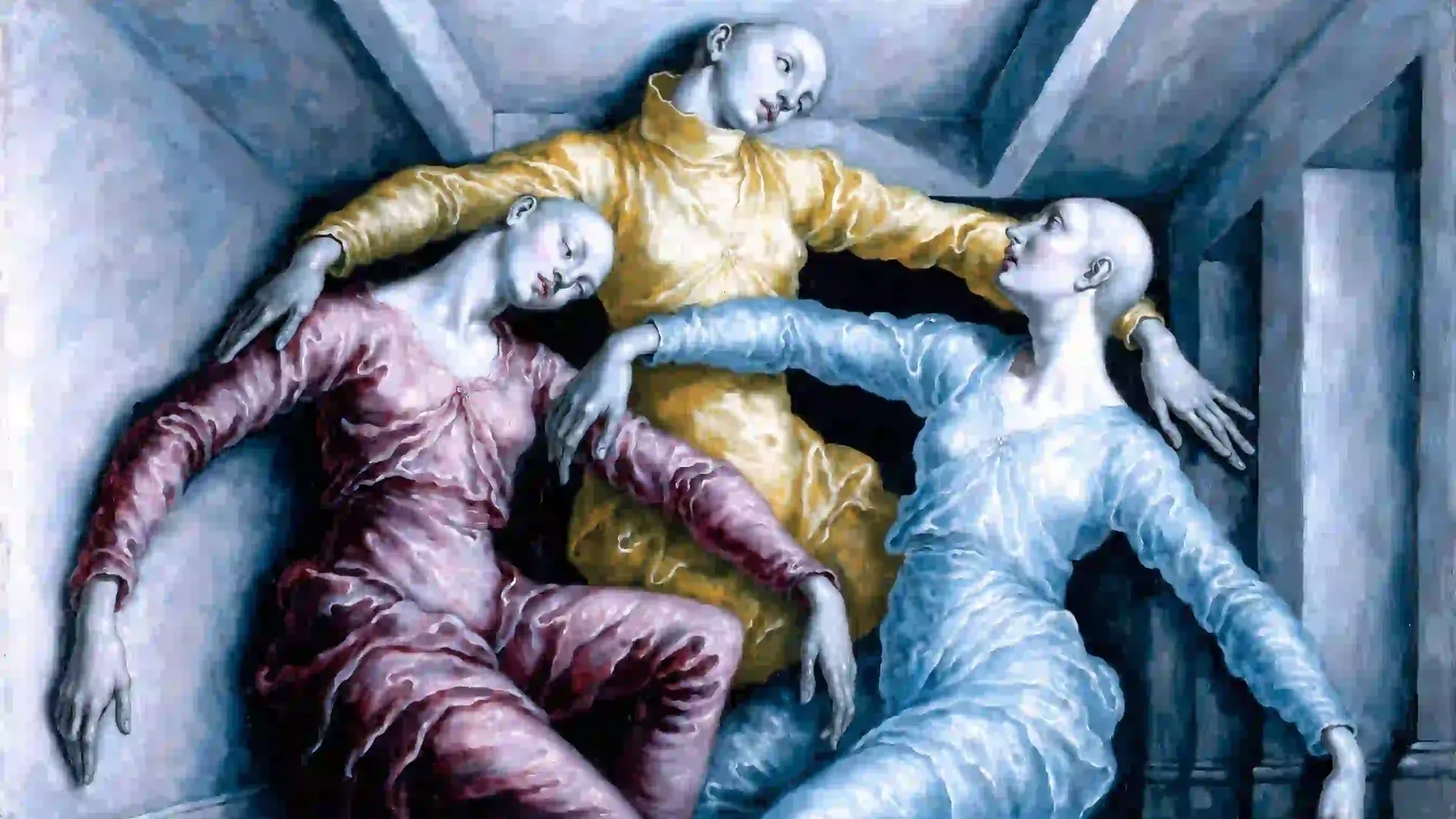
Artists such as Pontormo, Rosso Fiorentino, Parmigianino and Bronzino in Italy, and later El Greco in Spain, made figures longer and more twisted than life, compressed space, and used sharp, sometimes acidic colours. It was a time of crisis, including the Sack of Rome in 1527 and the Reformation, and much Mannerist art carries a refined anxiety.
Visual anatomy of Mannerism
Long limbs, small heads, long necks, hands with tapering fingers.
The figura serpentinata: a body twisting in a spiral, like a flame.
Crowded, shallow or illogical; figures pressed to the front, no clear ground.
Cool, sharp and unusual: lemon, rose, acid green, ice blue, shot fabrics that change colour.
Smooth, polished, almost enamel-like skin, especially in Bronzino.
Elegant, artificial, tense; emotion held in a frozen pose.
Key works of Mannerism
Floating figures in pink and blue with no cross and no ground, in the Church of Santa Felicita, Florence.
A swan-necked Virgin and an impossibly long Christ child, Uffizi Gallery, Florence.
Cold, polished bodies packed with riddles, National Gallery, London.
Elongated figures and a heaven of flickering light, Toledo.
How to recognize Mannerism
- Figures longer and more twisted than real bodies.
- Space that does not quite make sense.
- Cool, surprising colour combinations.
- Polished, artificial elegance.
- Many figures pressed into the front of the picture.
Where people get it wrong
Mannerism is sometimes treated as a failed Renaissance, as if the artists could not draw correctly. They could; the distortions were deliberate, a sophisticated play with the rules their teachers had set. Another mistake is to apply the term to any elongated figure, such as Modigliani; Mannerism is a historical period with its own context.
Words to describe Mannerism
Precise words for the qualities above. Combine a few of them instead of naming the style or artist alone.
- Mannerism
- maniera
- figura serpentinata
- elongation
- contrapposto
- shot colour
- compressed space
- artifice
- Late Renaissance
- Vasari
A Mannerist portrait study: a pale young man with a long neck and long fingers, twisted at the waist, in a lemon and rose silk doublet against a cramped grey architecture, skin smooth as enamel, gaze cool and distant.
What to take from Mannerism today
- Say how the figure is stretched or twisted.
- Describe space as crowded or impossible.
- Name the cool, unusual colours.
- Keep surfaces smooth and polished.
Manner as a mirror
Mannerism is what happens when a style becomes self-aware: art about art. It is close to what happens with Gen AI images when a look is repeated until it becomes 'manner'. The Mannerists turned that into a choice. The lesson for describing images is to name the distortion and say what it is for, not just that it is there.
Questions about Mannerism
What is Mannerism in art?
A style of European, mainly Italian, art from about 1520 to 1600, between the High Renaissance and the Baroque, known for elongated, twisting figures, compressed space and unusual colour.
What are the characteristics of Mannerism?
Elongated figures, serpentine poses, crowded or illogical space, cool or acidic colours, polished surfaces and an elegant but tense mood.
How is Mannerism different from the Renaissance?
High Renaissance art aims at balance, clear space and natural proportion. Mannerism deliberately stretches proportion, crowds the space and favours elegance and strangeness over harmony.
Who are the main Mannerist artists?
Pontormo, Rosso Fiorentino, Parmigianino, Bronzino and Giulio Romano in Italy, the sculptor Giambologna, and El Greco in Spain.
Find Parmigianino's Madonna with the Long Neck in the Uffizi's online collection. List every proportion that is not natural, then describe what feeling each distortion creates.
Sources and further reading
- John Shearman, Mannerism, Penguin, 1967.
- Linda Murray, The Late Renaissance and Mannerism, Thames & Hudson, 1967.
- National Gallery, London: Bronzino, An Allegory with Venus and Cupid.
- Uffizi Galleries: Parmigianino, Madonna with the Long Neck.