Self-taught and serious
Naive art is a term for work by artists who had no formal academic training, but who often painted with great dedication and skill of their own. The best-known is Henri Rousseau (1844–1910), a Paris customs official nicknamed 'Le Douanier', who began exhibiting in his forties and painted jungles he had never visited, using plants he studied in the Jardin des Plantes and in books.
The avant-garde admired him: Picasso held a famous banquet in his honour in 1908. Other painters often grouped under the term include Niko Pirosmani in Georgia, Séraphine Louis in France, Grandma Moses in the United States, and the peasant painters of the Hlebine school in Croatia. The older label 'primitive' is now avoided as condescending.
Visual anatomy of Naive Art
Flat or inconsistent: things are stacked up the picture rather than receding.
Every leaf, brick and blade of grass painted individually.
Bright, clear and often unblended, with strong outlines.
Frontal, still, sometimes stiff; proportions follow importance rather than optics.
Village life, festivals, animals, saints, jungles, dreams.
Calm, sincere, wondering; sometimes strange and dreamlike.
Key works and names
A tiger in a jungle lashed by a storm, National Gallery, London.
A woman asleep in a moonlit desert with a lion, Museum of Modern Art, New York.
Georgian painter of feasts, animals and taverns, often on black oilcloth.
Croatian painters who worked on the back of glass, with bright village scenes.
How to recognize Naive Art
- Flat or stacked perspective.
- Bright, unblended colour.
- Extreme care for small details.
- Still, frontal figures.
- A sincere, unironic tone.
Where people get it wrong
Naive art is sometimes confused with art brut or outsider art. Naive artists usually want to paint in a recognisable tradition and often sell and exhibit; art brut, as Jean Dubuffet defined it, is work made outside culture altogether, often by people in isolation. Another mistake is to treat 'naive' as 'childish'; the best naive painting is deliberate, patient and highly skilled in its own terms.
Words to describe Naive Art
Precise words for the qualities above. Combine a few of them instead of naming the style or artist alone.
- naive art
- self-taught
- flat perspective
- Le Douanier
- folk painting
- Hlebine
- frontality
- decorative detail
- bright colour
- sincerity
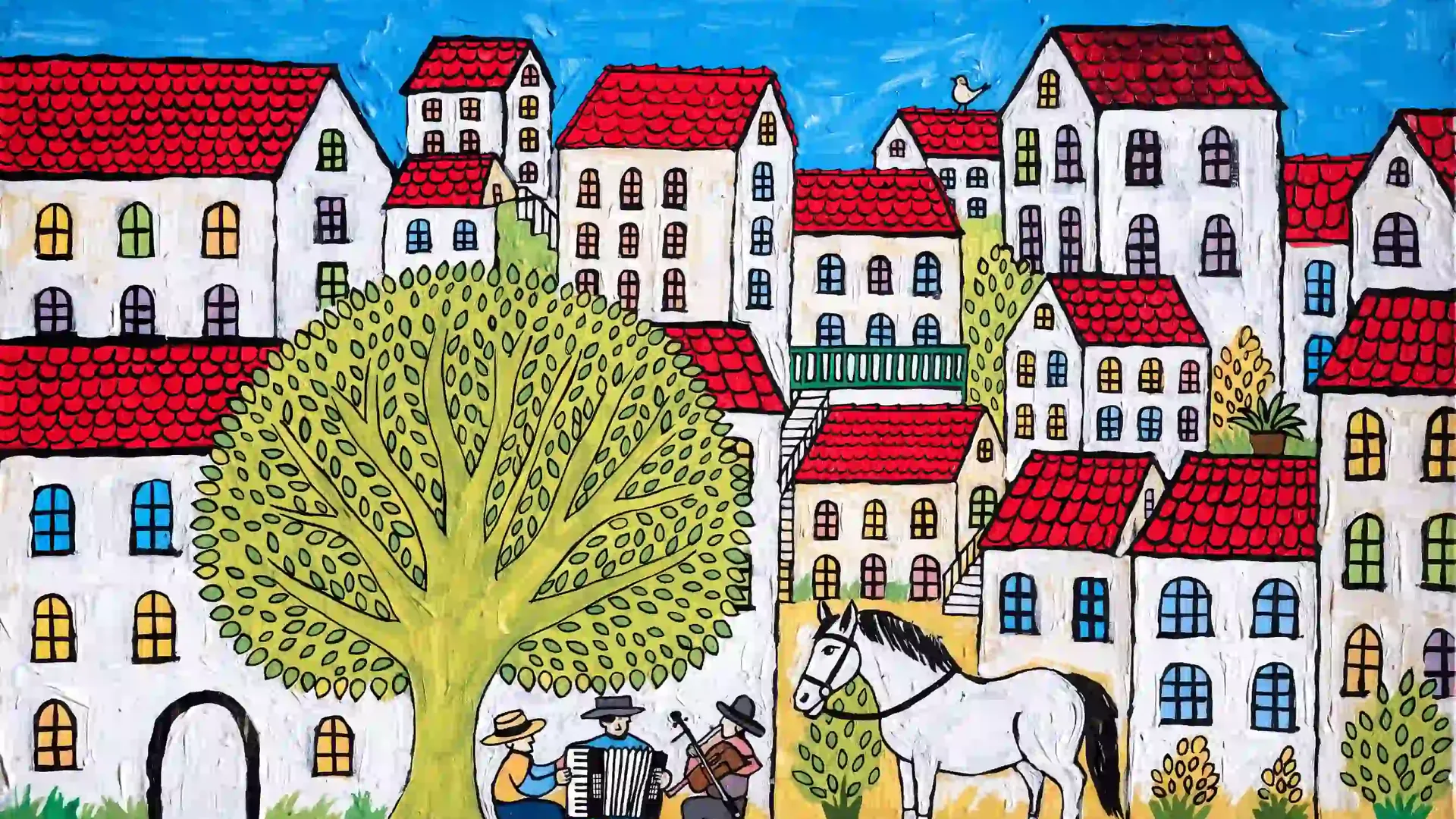
A naive-style study: a village square seen as if stacked upward, every red roof tile drawn, a band playing under a lime tree with each leaf painted, a white horse standing very still in the foreground, sky a clear even blue.
What to take from Naive Art today
- Stack the space instead of making it recede.
- Ask for every leaf and window to be painted one by one.
- Use bright, flat colour with outlines.
- Keep figures still and facing forward.
What you know, not what you see
Naive painting describes the world the way a list does: this tree, this cow, this window, each given full attention. It is thick description by accumulation. In prompting, it is a reminder that naming things one by one, with care, can be a style in itself.
Questions about Naive Art
What is naive art?
Art made by artists without formal academic training, typically with flat perspective, bright colour, detailed patterns and a sincere, direct approach. Henri Rousseau is the best-known example.
Who are famous naive artists?
Henri Rousseau, Niko Pirosmani, Séraphine Louis, Grandma Moses, Ivan Generalić of the Hlebine school, and many folk and village painters.
What is the difference between naive art and outsider art?
Naive artists are self-taught but usually work within a recognisable tradition and art world. Outsider art, or art brut, describes work made entirely outside the art world, often by people in isolation.
Paint or describe your street as a naive painter would: no perspective, every house facing you, every window counted, every tree with its leaves, the people standing still in their Sunday clothes.
Sources and further reading
- National Gallery, London: Henri Rousseau, Surprised!
- Museum of Modern Art, New York: Henri Rousseau, The Sleeping Gypsy.
- Oto Bihalji-Merin, Masters of Naive Art, McGraw-Hill, 1971.
- Tate: Art term 'naive art'.