The return of painting
In the late 1970s and early 1980s, painters in several countries turned against the cool, idea-based art of the previous decade. In Germany, Georg Baselitz had been painting figures upside down since 1969, and Anselm Kiefer, Jörg Immendorff and A. R. Penck confronted German history and myth; younger artists were called the 'Neue Wilde'. In Italy the critic Achille Bonito Oliva named the 'Transavanguardia': Sandro Chia, Francesco Clemente, Enzo Cucchi.
In the United States, Julian Schnabel painted on broken plates, David Salle layered images, and Jean-Michel Basquiat combined words, crowns, skulls and anatomy in a raw, urgent painting language. Exhibitions such as 'A New Spirit in Painting' at the Royal Academy in London (1981) and 'Zeitgeist' in Berlin (1982) made it an international moment, closely tied to a booming art market.
Visual anatomy of Neo-Expressionism
Very large canvases, often mural-sized.
Thick, fast, gestural; scraped, dripped, sometimes mixed with straw, ash or broken objects.
Rough, distorted human figures, heads, animals.
Myth, history, identity, violence, the body, the city.
Intense and clashing, or heavy earth and ash tones (Kiefer).
Raw, urgent, emotional, confrontational.
Words around Neo-Expressionism
'New Wild Ones', young German painters of the early 1980s.
The Italian version, named by Achille Bonito Oliva.
Julian Schnabel's paintings on broken crockery fixed to the canvas.
How to recognize Neo-Expressionism
- Large, expressive, figurative paintings.
- Thick, rough, visible paint.
- Myth, history or personal symbols.
- Words, crowns, skulls or scrawled marks (in Basquiat).
Where people get it wrong
Neo-Expressionism is sometimes treated as a simple revival of early 20th-century Expressionism. It borrowed its energy, but it was also ironic, historical and market-driven, and in Germany it dealt directly with the legacy of the Nazi era. Another mistake is to reduce Basquiat to graffiti; he was a studio painter drawing on art history, anatomy books and Black history.
Words to describe Neo-Expressionism
Precise words for the qualities above. Combine a few of them instead of naming the style or artist alone.
- Neo-Expressionism
- Neue Wilde
- Transavanguardia
- gestural
- impasto
- figuration
- mixed media
- myth
- history painting
- art market
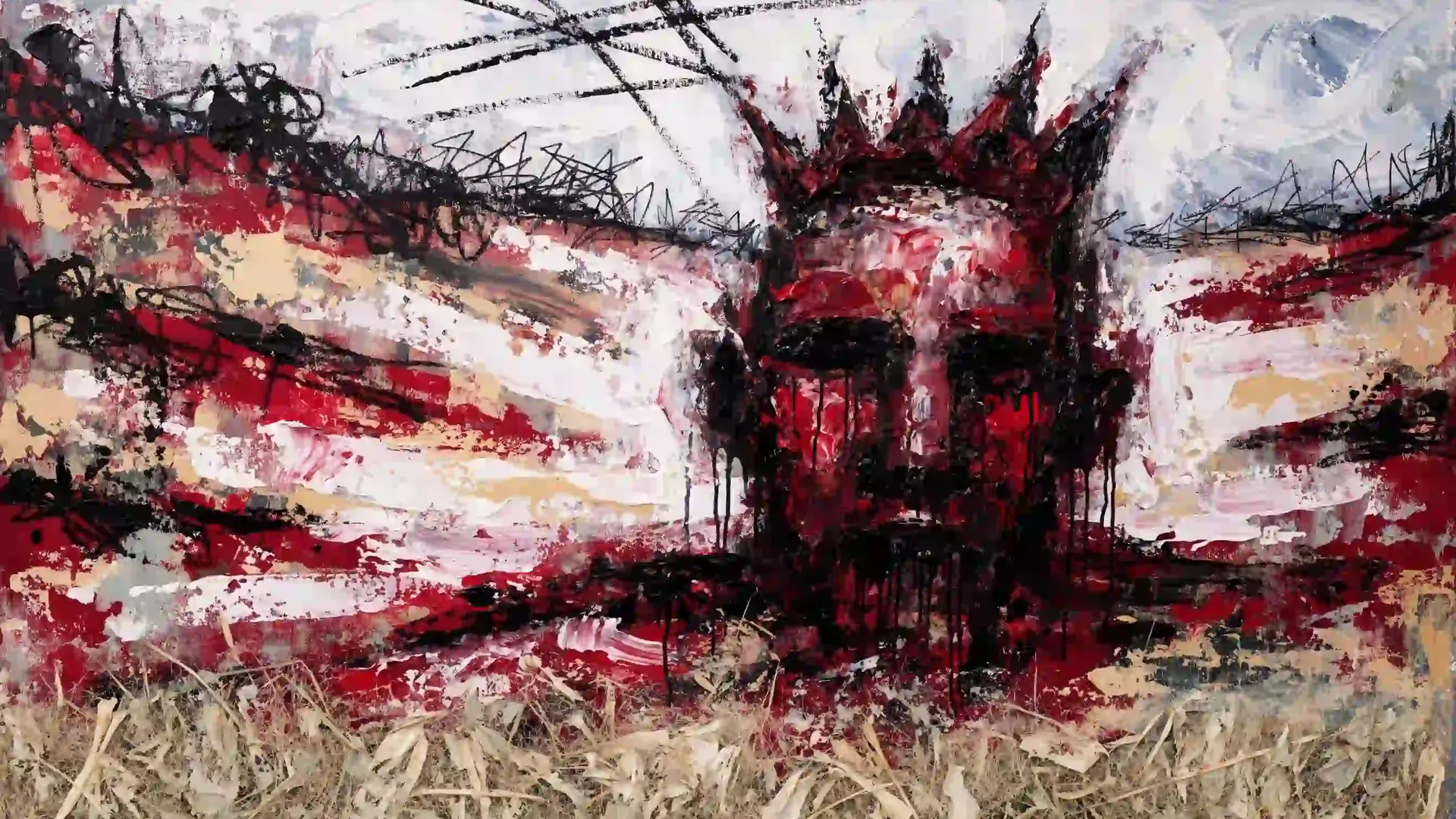
A study in the Neo-Expressionist manner: a huge canvas of a crowned head in thick red and black paint, scraped and dripped, a few crossed-out words scrawled across the top, straw pressed into the lower edge. Not a copy of any existing painting.
What to take from Neo-Expressionism today
- Give the scale and the speed of the paint.
- Describe the figures as rough and distorted.
- Name the materials mixed into the surface.
- Say which myth, history or symbol is present.
Noise as a sentence
Neo-Expressionism shouts, but its best works say something specific: Kiefer's ash and straw speak of burned land and memory, Basquiat's crossed-out words make you read what was crossed out. Describing it well means finding the exact sentence inside the noise.
Questions about Neo-Expressionism
What is Neo-Expressionism?
A movement of the late 1970s and 1980s in Germany, Italy and the United States that returned to large, raw, figurative and emotional painting after the dominance of conceptual and minimal art.
Who are the main Neo-Expressionist artists?
Georg Baselitz, Anselm Kiefer, Jörg Immendorff and A. R. Penck in Germany; Sandro Chia, Francesco Clemente and Enzo Cucchi in Italy; Julian Schnabel, David Salle and Jean-Michel Basquiat in the US.
Was Basquiat a Neo-Expressionist?
He is often grouped with the movement because of his raw, figurative painting in early-1980s New York, though his work also draws on graffiti, jazz, anatomy and Black history and resists any single label.
Find a Kiefer painting in a museum's online collection. Describe it only through its materials and their associations: what is ash, straw or lead doing in the picture, and what does it make you think of?
Sources and further reading
- Royal Academy of Arts, A New Spirit in Painting, exhibition catalogue, 1981.
- Achille Bonito Oliva, The Italian Trans-avantgarde, Giancarlo Politi Editore, 1980.
- Tate: Art term 'neo-expressionism'.
- Whitney Museum of American Art: Jean-Michel Basquiat collection notes.