Painting what is there
Realism appeared in France in the 1840s and 50s, in the years of revolution and industrialisation and just after the invention of photography (1839). Gustave Courbet declared that he would paint only what he could see. His huge A Burial at Ornans (1849–50) showed a village funeral at the size usually reserved for heroes and gods, and when the 1855 World's Fair rejected some of his works, he built his own 'Pavilion of Realism' next to it.
Jean-François Millet painted peasants at work, as in The Gleaners (1857), and Honoré Daumier caricatured and observed the life of Paris. Realism rejected idealised beauty, mythology and academic polish, and its focus on modern, ordinary life opened the way for Impressionism.
Visual anatomy of Realism
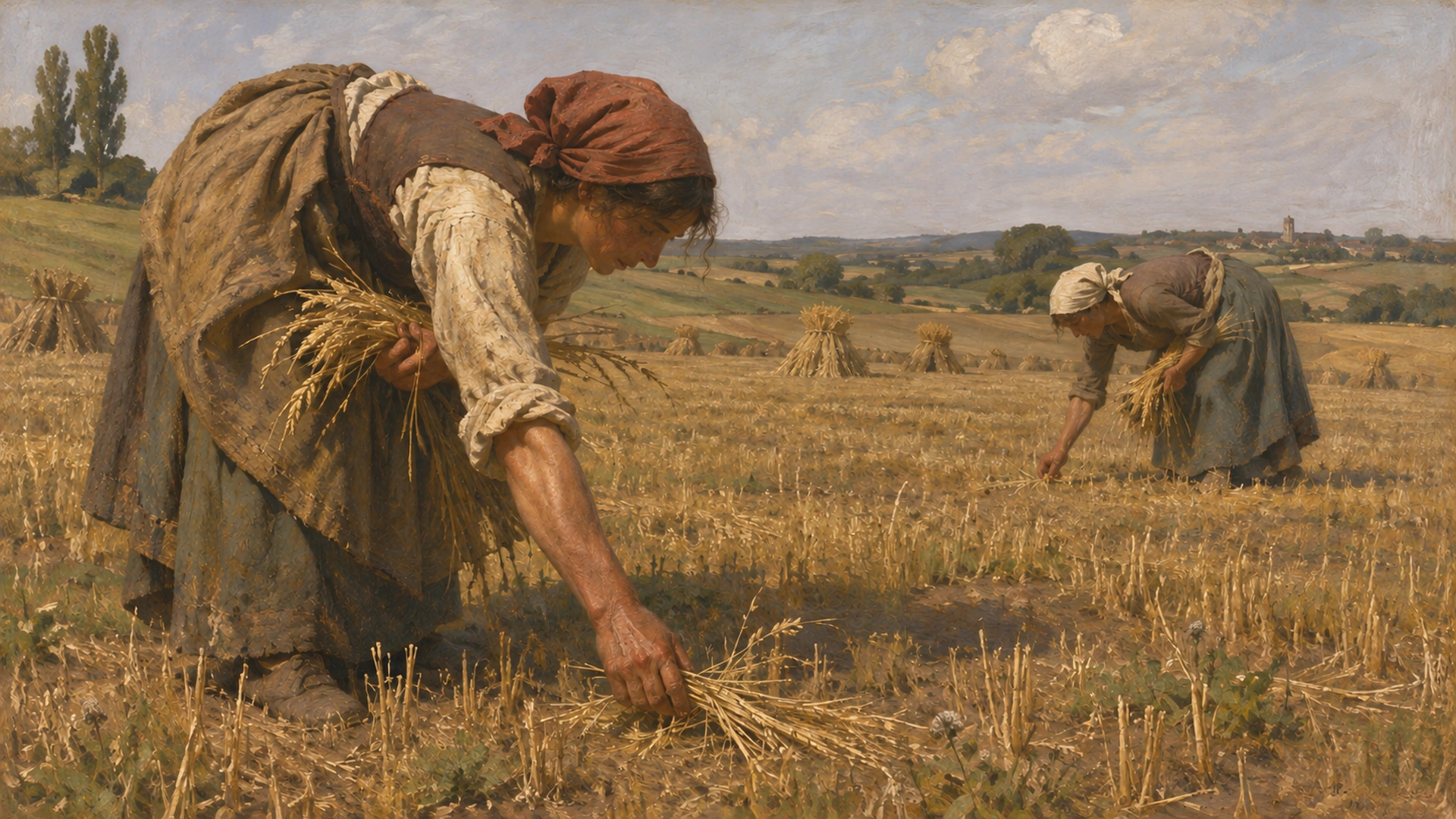
Workers, peasants, villages, everyday labour and modern life.
Ordinary scenes painted large, with the seriousness of history painting.
Real, unidealised bodies and faces, often tired or rough.
Earthy browns, greens and greys; heavy, solid paint.
Natural, often flat daylight rather than theatrical drama.
Direct and unsentimental, sometimes political.
Key artists of Realism
A Burial at Ornans and The Stone Breakers: the manifesto of Realism.
Peasants at work with quiet dignity, The Gleaners.
Paintings and caricatures of the people of Paris.
Powerful, precisely observed animals and rural work.
How to recognize Realism
- Ordinary people and work as the main subject.
- Unidealised bodies in natural light.
- Earthy colour and a serious, direct tone.
Where people get it wrong
'Realism' as a movement is not the same as 'realistic'. Many styles are realistic in technique; Realism with a capital R was about choosing ordinary modern life as a worthy subject. It is also different from Photorealism and Hyperrealism, which copy photographs in the 1960s and later.
Words to describe Realism
Precise words for the qualities above. Combine a few of them instead of naming the style or artist alone.
- 19th-century Realism
- peasants at work
- unidealised figures
- earthy browns and greens
- natural daylight
- large-scale everyday scene
- rural labour
- heavy solid paint
- dignity of ordinary life
- direct unsentimental tone
An original study in the manner of 19th-century Realist painting: two women bending to gather wheat in a wide harvested field, their backs and rough hands in natural afternoon light, earthy browns, ochres and muted greens, a low horizon, a serious and quiet mood.
What to take from Realism today
- Name the everyday subject and the work being done.
- Describe the bodies and faces without beautifying them.
- Give the palette and the light: earthy, natural, flat.
Questions about Realism
What is Realism?
The 19th-century French movement that painted ordinary people and everyday labour as they were, at the scale of history painting, without idealising them.
How do you recognize Realism?
Ordinary people and work as the main subject. Unidealised bodies in natural light. Earthy colour and a serious, direct tone.
How do you describe Realism in words or a prompt?
Name the everyday subject and the work being done. Describe the bodies and faces without beautifying them. Give the palette and the light: earthy, natural, flat.
Watch someone at work for a few minutes, such as a baker, a cleaner or a builder. Describe them as a Realist painting: their posture, their hands, the tools, the light and the colours, without making them prettier.