Fibre, water and a frame
Paper is made by beating plant fibres into pulp, lifting it from water on a screen called a mould, and letting the fibres mat and dry. Chinese tradition credits the court official Cai Lun with improving papermaking around 105 CE, and the craft spread across Asia, the Islamic world and Europe.
Japanese washi, made from the inner bark of plants such as kozo, is strong, light and translucent; in 2014 UNESCO listed the craftsmanship of traditional Japanese handmade paper as Intangible Cultural Heritage. In the West, cotton rag paper is prized by printers and artists. Handmade paper is now used in design for invitations, packaging, books and art, often with its rough deckle edges left on purpose.
Visual anatomy of handmade paper
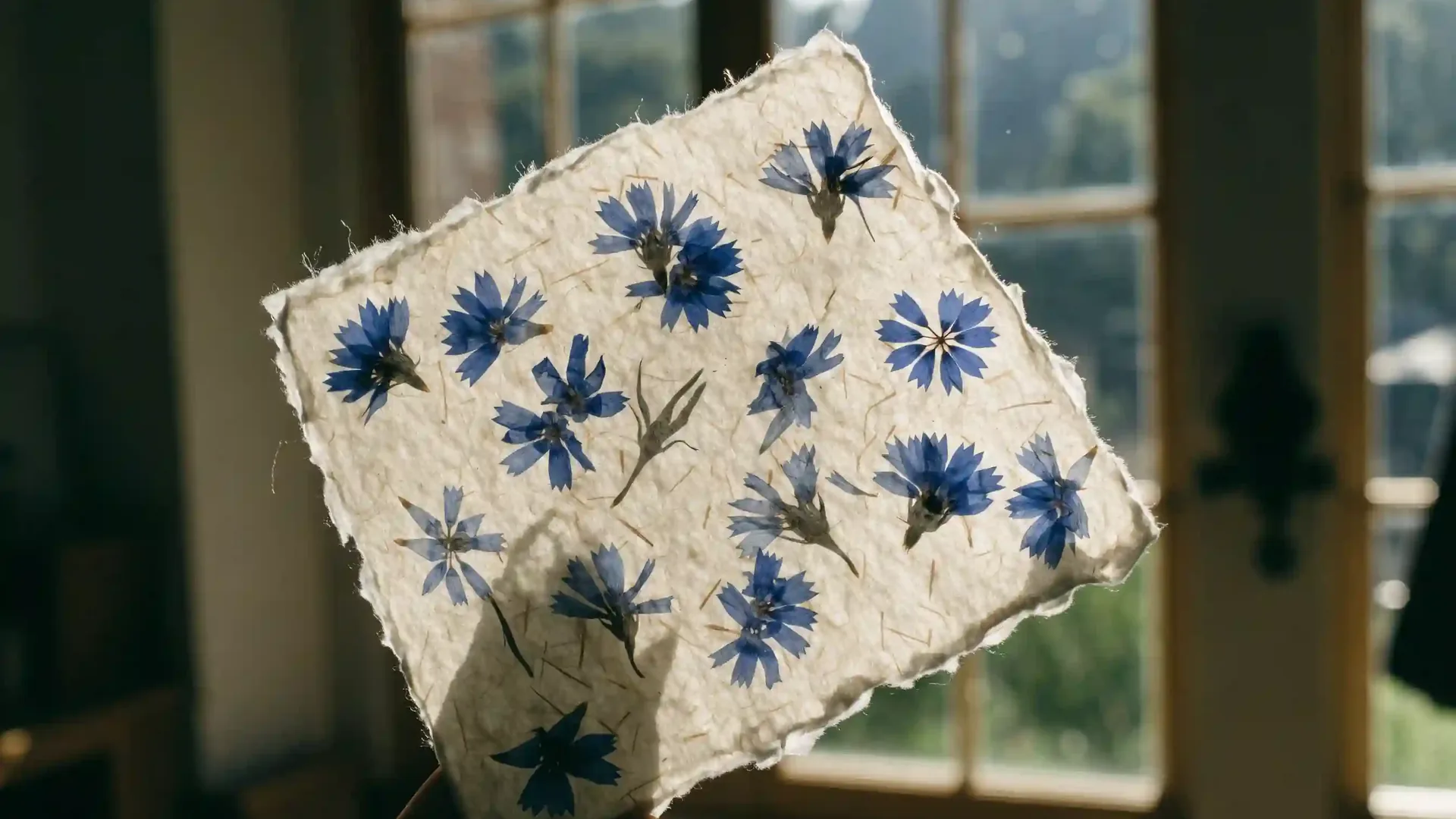
Feathered, irregular 'deckle' edges where the pulp met the frame.
Visible strands and flecks, sometimes long and silky (washi).
Soft, uneven, absorbent; slight variations in thickness.
Petals, leaves, threads or seeds pressed into the sheet.
Thin sheets glow when light passes through them.
Warm, organic, quiet, singular.
Words around paper
The screen that lifts the pulp and the frame that shapes its edges.
Traditional Japanese handmade paper, often from kozo bark.
Paper made from cotton or linen fibres.
Making images with coloured pulp during papermaking.
How to recognize handmade paper
- Rough, feathered edges.
- Visible fibres and flecks.
- Slightly uneven thickness.
- Glow when held to the light.
Where people get it wrong
Handmade paper is often imitated with a digital texture laid over a flat image. Real paper changes how ink sits: it spreads, soaks and catches. If you design for it, test real printing on the actual sheet, and keep text away from the deckle edge.
Words to describe handmade paper
Precise words for the qualities above. Combine a few of them instead of naming the style or artist alone.
- handmade paper
- deckle edge
- mould
- pulp
- washi
- kozo
- rag paper
- inclusions
- translucency
- pulp painting
A handmade paper study: a sheet of cream cotton rag paper with deckle edges and pressed blue cornflower petals, held against a window so the fibres glow.
What to take from handmade paper today
- Name the fibre: cotton rag, kozo, recycled.
- Describe the edge and the surface.
- Mention any inclusions.
- Say how light passes through it.
A page that remembers
A handmade sheet carries its making the way a face carries its years. It is a useful image for writing too: the edge that was not trimmed is the part that tells you where the page came from.
Questions about handmade paper
What is a deckle edge?
The rough, feathered edge of handmade paper, formed where the pulp meets the frame of the mould. Some papers have it imitated by machine.
What is washi paper?
Traditional Japanese handmade paper, usually made from the inner bark of plants such as kozo, known for strength, lightness and translucency.
Can you print on handmade paper?
Yes, especially with letterpress, screenprinting, risograph and some inkjet printers, but test first: the texture and absorbency change how ink behaves.
Hold three different papers up to a window: printer paper, a paper bag and any handmade or textured sheet. Describe the light, the fibres and the edges of each.
Sources and further reading
- UNESCO: Washi, craftsmanship of traditional Japanese hand-made paper (inscribed 2014).
- Dard Hunter, Papermaking: The History and Technique of an Ancient Craft, Dover, 1978 (first published 1943).
- Robert C. Williams Museum of Papermaking, Georgia Institute of Technology.