Photography without a lens
The pinhole is the oldest optical idea in photography. The camera obscura, a dark room where light through a small hole projects an upside-down image of the outside world, was described by ancient Chinese and Greek writers and by the scholar Ibn al-Haytham around 1000 CE. In the 1850s photographers began putting film or plates behind a pinhole; the first known pinhole photographs date from that decade.
Because there is no lens, everything from near to far is equally sharp, and equally soft. The tiny aperture needs long exposures, so moving people blur or vanish. Artists love its uncertainty: cameras made from biscuit tins, matchboxes or whole rooms, and 'solargraphs' that record the sun's path across the sky over months. Worldwide Pinhole Photography Day is held each April.
Visual anatomy of pinhole photography
Soft overall, but with almost infinite depth of field.
Darker corners and edges, especially with wide pinhole cameras.
Seconds to hours; movement turns into ghosts.
Curved or stretched perspective, depending on the camera's shape.
Often film grain, light leaks and uneven development.
Quiet, nostalgic, dreamlike, slightly uncanny.
Key terms in pinhole photography
A darkened room or box that projects an image through a small hole.
Very long pinhole exposures, recording the sun's daily arcs over weeks or months.
Pinhole cameras have tiny apertures, often f/150 or smaller.
Stray light entering the camera, leaving glowing streaks.
How to recognize pinhole photography
- Soft images with everything equally in focus.
- Dark vignetting at the corners.
- Ghostly motion from long exposures.
Where people get it wrong
Pinhole is often confused with simply blurry or vintage photos. Its signature is that nothing is in or out of focus: near and far share the same soft sharpness, with vignetting and long-exposure ghosts. Shallow depth of field is the opposite of the pinhole look.
Words to describe pinhole photography
Precise words for the qualities above. Combine a few of them instead of naming the style or artist alone.
- pinhole photography
- lensless camera
- soft infinite depth of field
- dark vignetting
- ghostly long-exposure figures
- curved wide perspective
- film grain
- light leaks
- solargraph sun trails
- camera obscura projection
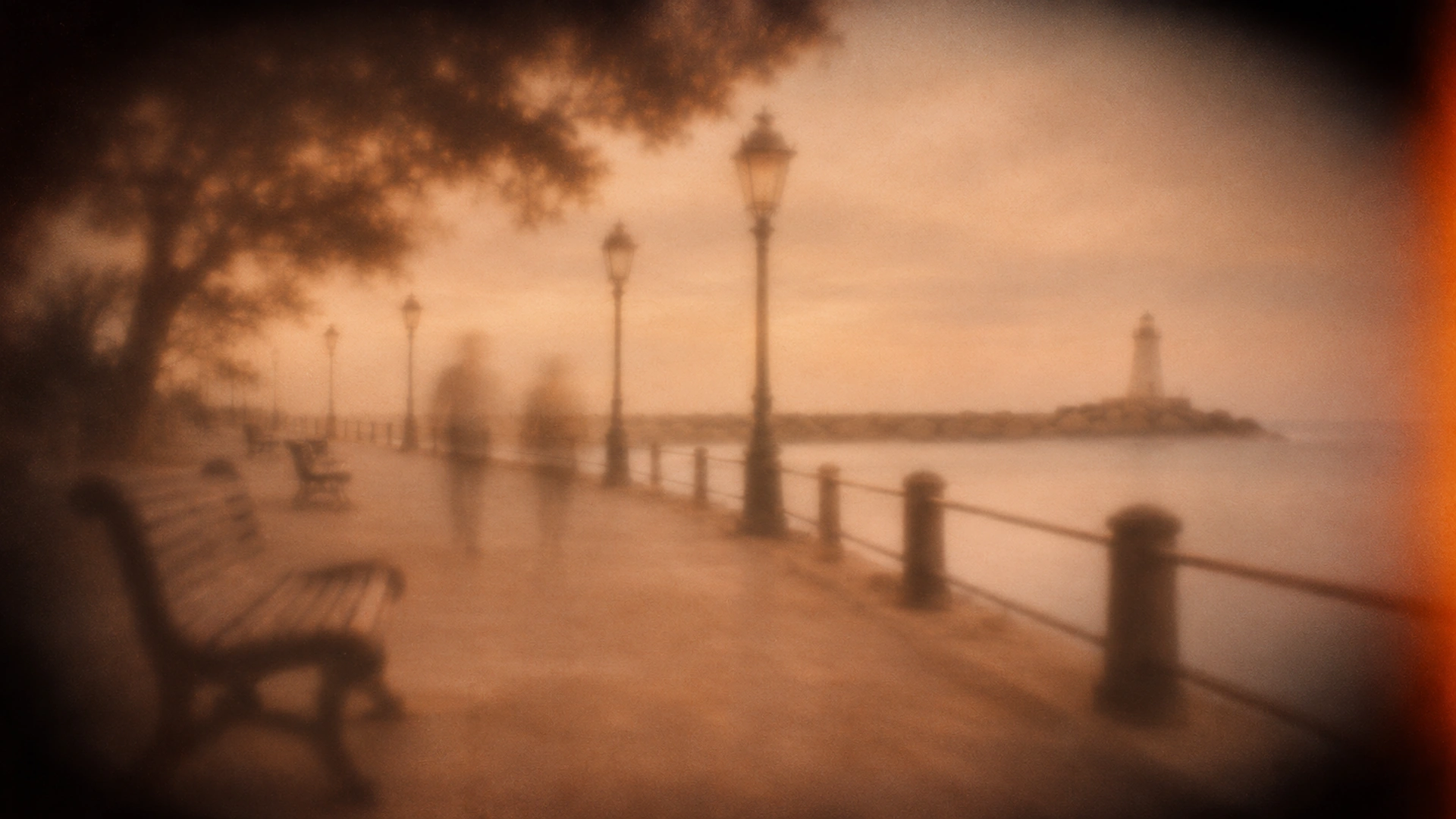
An original pinhole photograph: a quiet seaside promenade with benches and lamp posts, everything from the nearest bench to the far lighthouse equally soft, strong dark vignetting at the corners, two ghostly translucent walkers from a long exposure, smooth misty sea, warm film grain and a faint orange light leak on one edge. No text.
What to take from pinhole photography today
- Say lensless pinhole, with deep soft focus everywhere.
- Describe vignetting and any curvature.
- Add long-exposure effects: ghosts, smooth water, light leaks.
Questions about pinhole photography
What is pinhole photography?
Photographs made without a lens, through a tiny hole in a box: soft everywhere, nothing out of focus, dark corners, ghostly movement and a handmade, timeless feel.
How do you recognize pinhole photography?
Soft images with everything equally in focus. Dark vignetting at the corners. Ghostly motion from long exposures.
How do you describe pinhole photography in words or a prompt?
Say lensless pinhole, with deep soft focus everywhere. Describe vignetting and any curvature. Add long-exposure effects: ghosts, smooth water, light leaks.
Describe a pinhole photograph of a busy café terrace: what becomes ghostly, what stays solid, how dark the corners are and what a light leak adds.