Fashion as a question
Avant-garde fashion describes designers who use clothing to experiment rather than to flatter. A turning point came in 1981, when Rei Kawakubo of Comme des Garçons and Yohji Yamamoto showed in Paris: black, torn, asymmetric, loose garments that the press called 'Hiroshima chic' and that overturned ideas of glamour. Issey Miyake explored pleats and technology, and Kawakubo's 1997 'Body Meets Dress' collection added padded lumps to the body itself.
In the 1990s the Belgian Martin Margiela exposed seams, linings and unfinished edges, a 'deconstructivist' approach. Hussein Chalayan turned furniture into dresses, Alexander McQueen staged collections as theatre, and Iris van Herpen has used 3D printing and new materials since the late 2000s. For images, the genre is about form and idea first: silhouette, structure and material tell the story.
Visual anatomy of avant-garde fashion
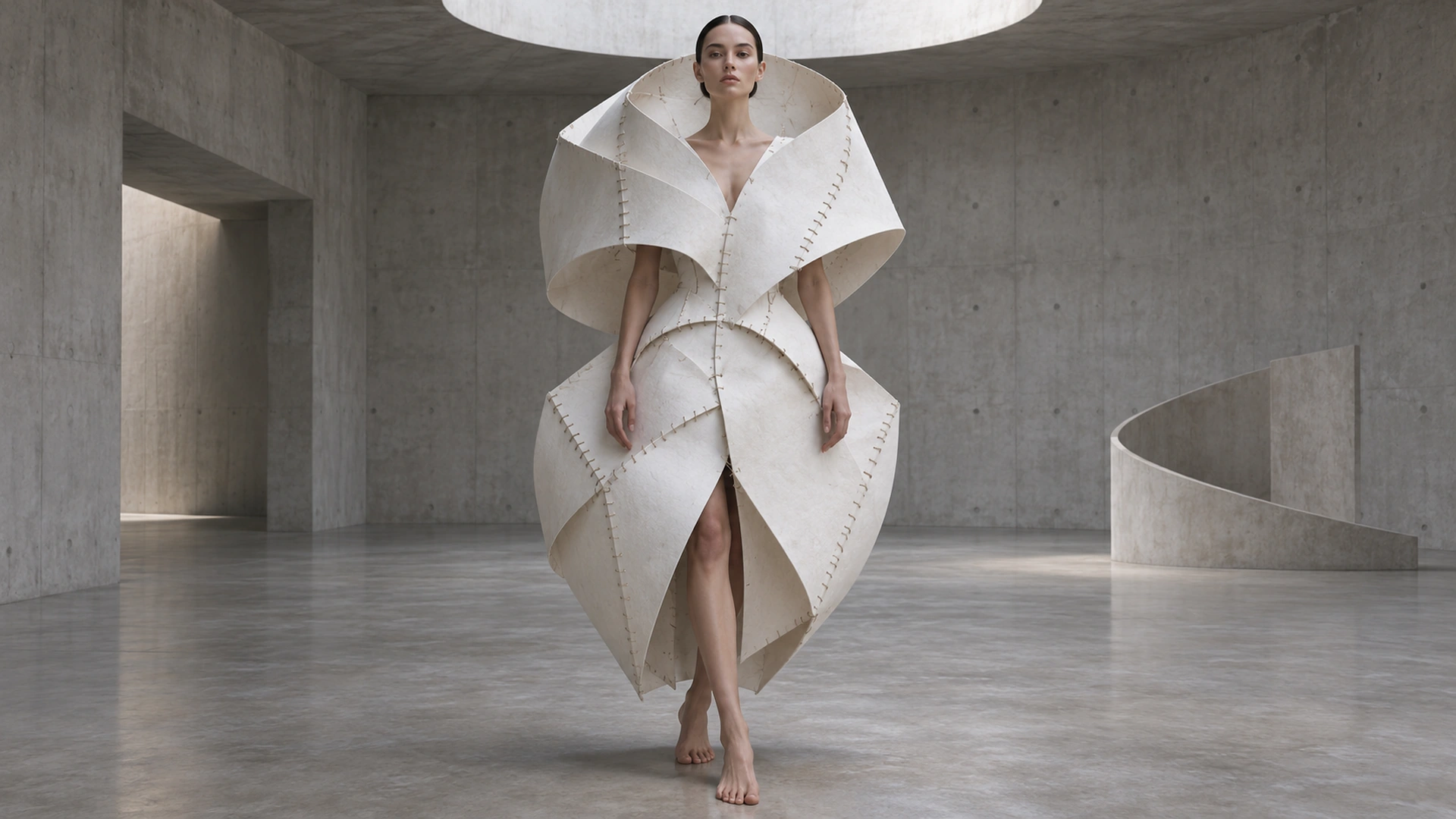
Volumes that distort or ignore the body: padding, cocoons, extreme shoulders.
Exposed seams, raw edges, linings outside, asymmetric cuts.
Unusual or technical: paper, plastic, metal, 3D-printed structures, felt.
Often black, white or monochrome so that form leads; sometimes one shocking colour.
Minimal accessories, sculptural hair or headpieces, serious expression.
Bare studios, galleries or stark architecture.
Key names
Black, torn, padded and sculptural; Body Meets Dress (1997).
Pleats, technology and garments as folded forms.
Deconstruction, anonymity and visible construction.
3D printing, laser cutting and forms inspired by nature and science.
How to recognize avant-garde fashion
- Sculptural silhouettes that change the body's outline.
- Exposed construction or unusual materials.
- Monochrome palette, stark setting.
Where people get it wrong
Avant-garde is often reduced to 'weird outfits'. The strongest work has a clear idea expressed through one or two radical choices, a silhouette, a construction method, a material, while everything else is restrained. Piling on strangeness reads as costume, not fashion.
Words to describe avant-garde fashion
Precise words for the qualities above. Combine a few of them instead of naming the style or artist alone.
- avant-garde fashion
- sculptural silhouette
- deconstructed garment
- exposed seams and raw edges
- padded body distortion
- 3D-printed fashion
- monochrome black garment
- pleated structure
- stark gallery setting
- conceptual runway look
An original avant-garde fashion photograph: a model in a sculptural white garment made of stiff folded paper-like panels that form a cocoon around the shoulders and hips, exposed stitched seams, bare feet, a stark concrete gallery, soft overhead light, calm serious expression, full-length shot. No text.
What to take from avant-garde fashion today
- Name the one radical idea: silhouette, construction or material.
- Describe how it changes the body's shape.
- Keep palette, styling and setting restrained.
Questions about avant-garde fashion
What is avant-garde fashion?
Clothes as experiments: sculptural volumes that reshape the body, garments turned inside out, unexpected materials and 3D-printed structures, made to question what fashion is.
How do you recognize avant-garde fashion?
Sculptural silhouettes that change the body's outline. Exposed construction or unusual materials. Monochrome palette, stark setting.
How do you describe avant-garde fashion in words or a prompt?
Name the one radical idea: silhouette, construction or material. Describe how it changes the body's shape. Keep palette, styling and setting restrained.
Design one avant-garde garment in words around a single idea, a coat that is also a tent, a dress made of paper folds. Describe its silhouette, material, construction and how it would be photographed.