Breaking the box
The name became public with the 1988 exhibition 'Deconstructivist Architecture' at the Museum of Modern Art in New York, curated by Philip Johnson and Mark Wigley. It showed seven architects, Frank Gehry, Zaha Hadid, Daniel Libeskind, Rem Koolhaas, Peter Eisenman, Bernard Tschumi and Coop Himmelb(l)au, whose work twisted and fragmented the modernist box. The name mixed Russian Constructivism with the philosopher Jacques Derrida's 'deconstruction'.
Computer design tools later made these forms buildable at scale: Gehry's Guggenheim Museum Bilbao (1997), Libeskind's Jewish Museum Berlin (2001) and Hadid's Vitra Fire Station (1993) became landmarks. In graphic design, a parallel 1990s movement broke grids and layered type, as in the magazine Ray Gun. Today the look survives in dramatic museums, sculptural brand stores and in images that want energy and instability.
Visual anatomy of Deconstructivism
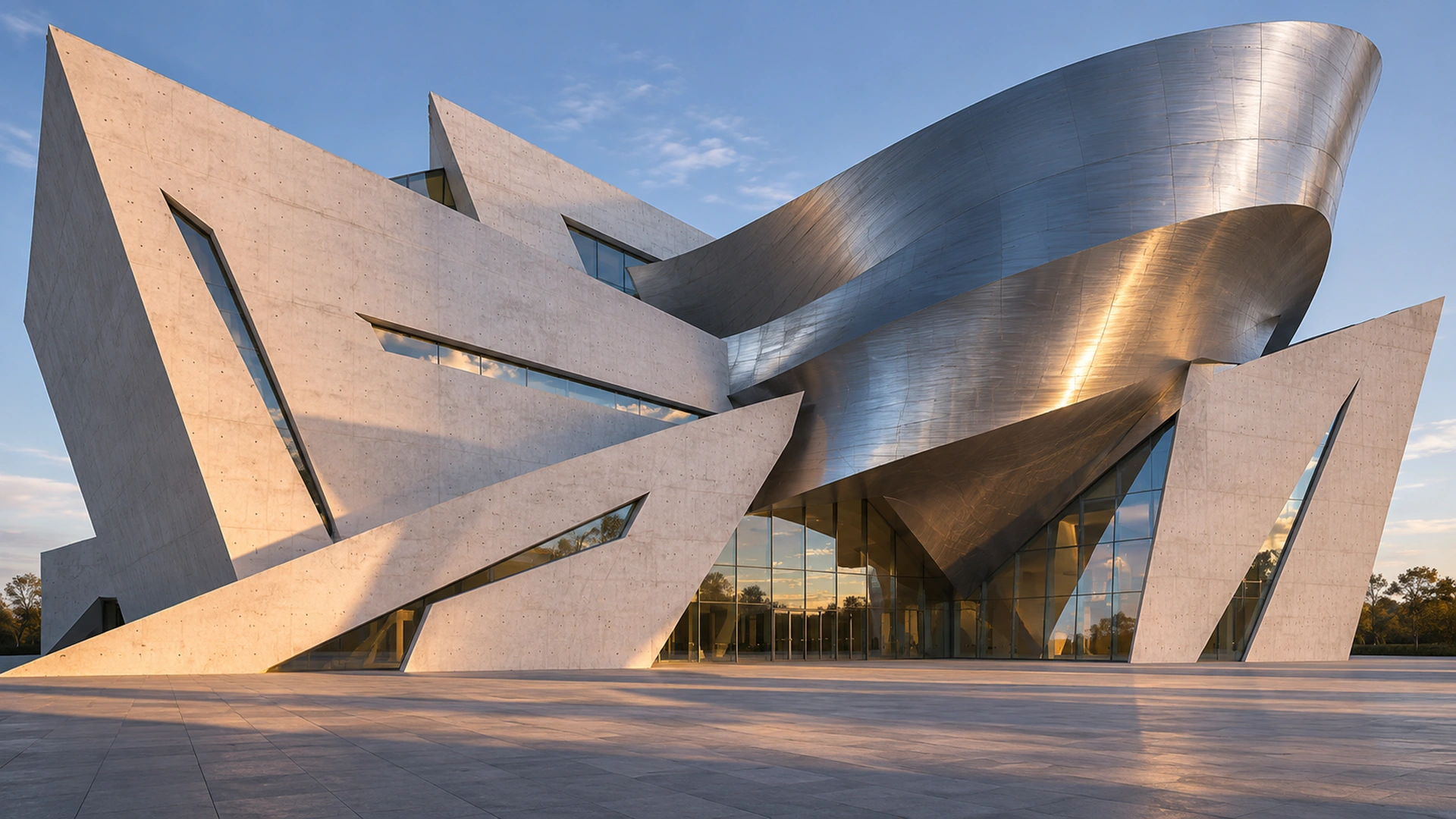
Fragmented, angular or flowing volumes that resist simple geometry.
Tilted walls, leaning planes, no obvious right angles.
Parts that seem to crash into or slide past each other.
Titanium, steel, glass and white concrete, often reflective.
Slashed windows and irregular cuts instead of regular rows.
Motion, tension and surprise; the building seems unfinished or exploding.
Key names
Curving titanium; Guggenheim Museum Bilbao (1997).
Sharp, dynamic shards and later flowing forms; Vitra Fire Station (1993).
Zigzag plans and slashed windows; Jewish Museum Berlin (2001).
Explosive roof structures and steel fragments.
How to recognize Deconstructivism
- Tilted, fragmented forms with few right angles.
- Shiny metal or white surfaces in dramatic light.
- Slashed or irregular windows.
Where people get it wrong
Deconstructivism is not the same as ruin or decay. The forms are precise and engineered; the instability is designed. Describing it as 'broken' or 'collapsing' leads to wreckage instead of architecture.
Words to describe Deconstructivism
Precise words for the qualities above. Combine a few of them instead of naming the style or artist alone.
- deconstructivist architecture
- fragmented angular volumes
- tilted walls
- colliding planes
- curving titanium cladding
- slashed windows
- sharp shard-like forms
- white concrete and glass
- dynamic unstable composition
- sculptural museum building
An original deconstructivist architecture study: a museum building of tilted white concrete planes and one huge curving brushed-metal volume colliding with them, narrow slashed windows, reflections of a pale blue sky, a wide empty plaza in front, late afternoon raking light. Not a copy of any existing building. No text.
What to take from Deconstructivism today
- Describe the main gesture: fold, shard, curve or collision.
- Name the surface material and how it catches light.
- Say how the building meets the ground and sky.
Questions about Deconstructivism
What is Deconstructivism?
Architecture that breaks the box: fragmented, tilted, colliding forms that look unstable on purpose, from Gehry's titanium curves to Hadid's sharp shards.
How do you recognize Deconstructivism?
Tilted, fragmented forms with few right angles. Shiny metal or white surfaces in dramatic light. Slashed or irregular windows.
How do you describe Deconstructivism in words or a prompt?
Describe the main gesture: fold, shard, curve or collision. Name the surface material and how it catches light. Say how the building meets the ground and sky.
Describe a bus shelter or a small library in deconstructivist style: its main gesture, its materials, its windows and the light on its surfaces.