The object as hero
Photographing things to sell them is as old as illustrated advertising, but it became an art in the 1920s, when photographers such as Edward Steichen brought modernist light and composition to advertisements for lighters, fabrics and cosmetics. Later, Irving Penn's still lifes for Vogue and his long-running cosmetics campaigns from the late 1960s showed how a few bottles on white could be as composed as a painting.
Today product photography ranges from the plain packshot that online shops require to elaborate hero images with splashing liquid and floating parts. Its core skills are the same: control of light on different materials. Matte surfaces need shape from soft directional light; glossy surfaces show whatever is around them, so the photographer lights the reflections rather than the object; glass and liquid are lit from behind or from the edges. Almost every choice, the angle, the surface, the shadow, is deliberate, which makes the genre a good school for describing images precisely.
Visual anatomy of product photography
Large soft sources (softbox, diffusion panel), strip lights for edges, backlight for glass.
Smooth gradient highlights on glossy surfaces; no stray reflections.
Seamless white sweep, coloured paper, acrylic, stone, or a lifestyle setting.
Straight-on, three-quarter, top-down flat lay, or low hero angle.
Soft grounding shadow, hard graphic shadow, or reflection on a glossy surface.
Everything sharp, often by focus stacking; or shallow focus for mood.
Types of shot
The product alone on pure white, evenly lit, for catalogues and online shops.
The dramatic main image: bold light, low angle, rich background.
The product in use or in a real setting, with props and people.
Objects arranged on a surface and photographed from directly above.
A close-up of texture, stitching, a logo or a mechanism.
Frozen liquid or floating parts, usually composited from several exposures.
How to recognize product photography
- One object or a small group is the clear subject.
- Light is clean and controlled, highlights are smooth.
- The background is simple and intentional.
- Colours and materials look accurate.
Where people get it wrong
Asking for a 'product photo' with no lighting or surface. The result is generic. The craft is in the specifics: what the object stands on, where the main light is, what the highlight looks like, how hard the shadow is. For shiny objects, describe the reflection: 'a long soft gradient highlight down the left side of the bottle'.
Words to describe product photography
Precise words for the qualities above. Combine a few of them instead of naming the style or artist alone.
- product photography
- packshot on white
- hero shot
- lifestyle shot
- flat lay
- softbox lighting
- gradient highlight
- rim light
- seamless background
- soft grounding shadow
- focus stacking
- three-quarter angle
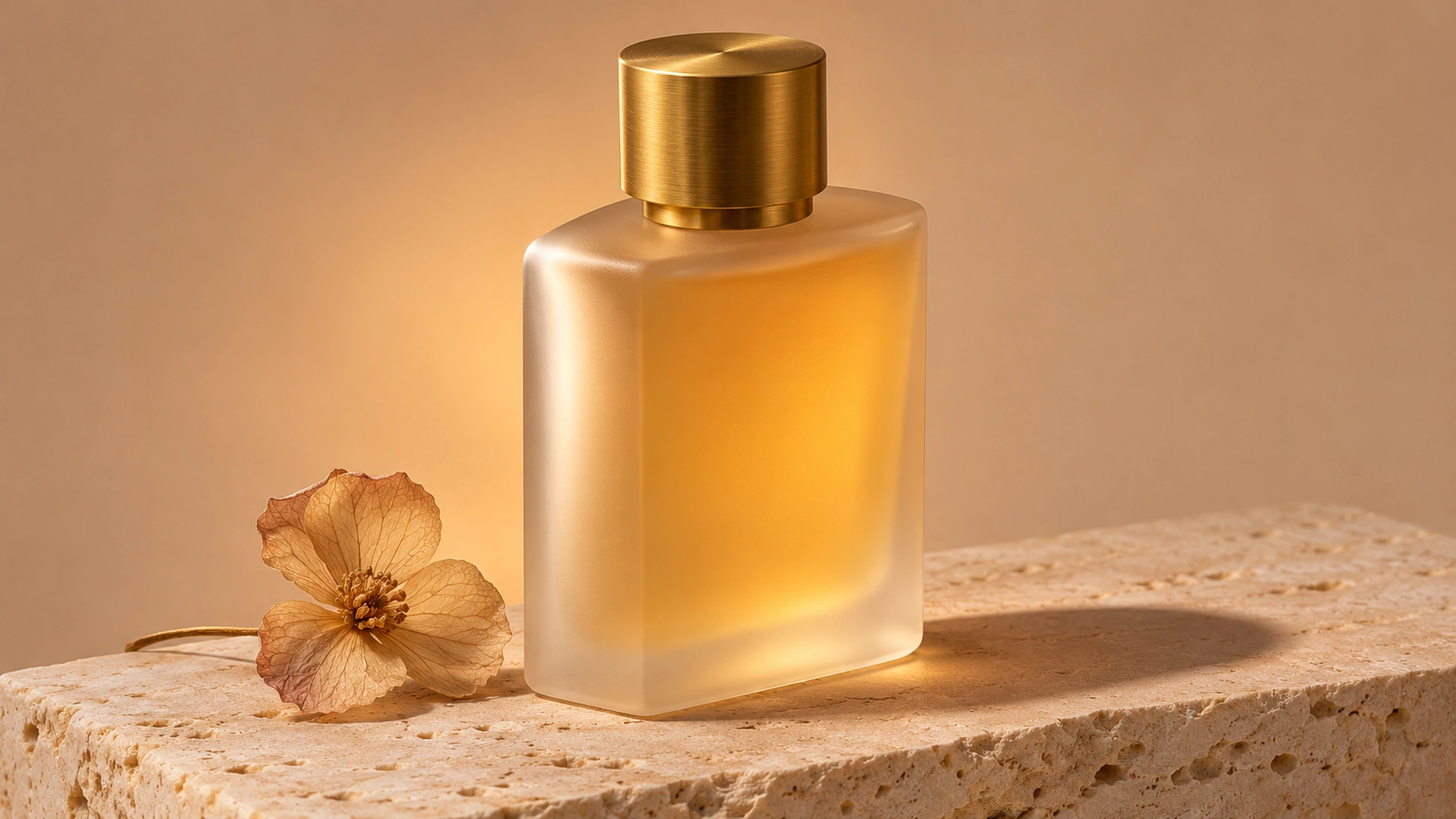
An original product photography study: a frosted glass perfume bottle with a brass cap standing on a slab of pale travertine, a long soft gradient highlight down its left side, warm backlight glowing through the liquid, a soft shadow to the right, a single dried flower beside it, muted sand background, three-quarter angle, everything in sharp focus. No label or text.
What to take from product photography today
- Name the shot type: packshot, hero, lifestyle, flat lay.
- Describe the surface and background.
- Place the light and describe highlight and shadow.
- State the material: frosted glass, brushed steel, matte ceramic.
Questions about product photography
What is a packshot?
A clean photograph of a product alone, usually on a pure white background with even lighting, used in catalogues and online shops.
How do you light glass and shiny products?
Light what the surface reflects, not the object: large diffused panels for smooth highlights, and backlight or edge light to define glass.
Pick an object near you and write two descriptions of it: a packshot (background, light, angle, shadow) and a hero shot (surface, main light, reflection, mood). Notice which words change.
Sources and further reading
- Fil Hunter, Steven Biver and Paul Fuqua, Light: Science and Magic (1990; 6th ed. 2021).
- John Szarkowski, Irving Penn (1984).