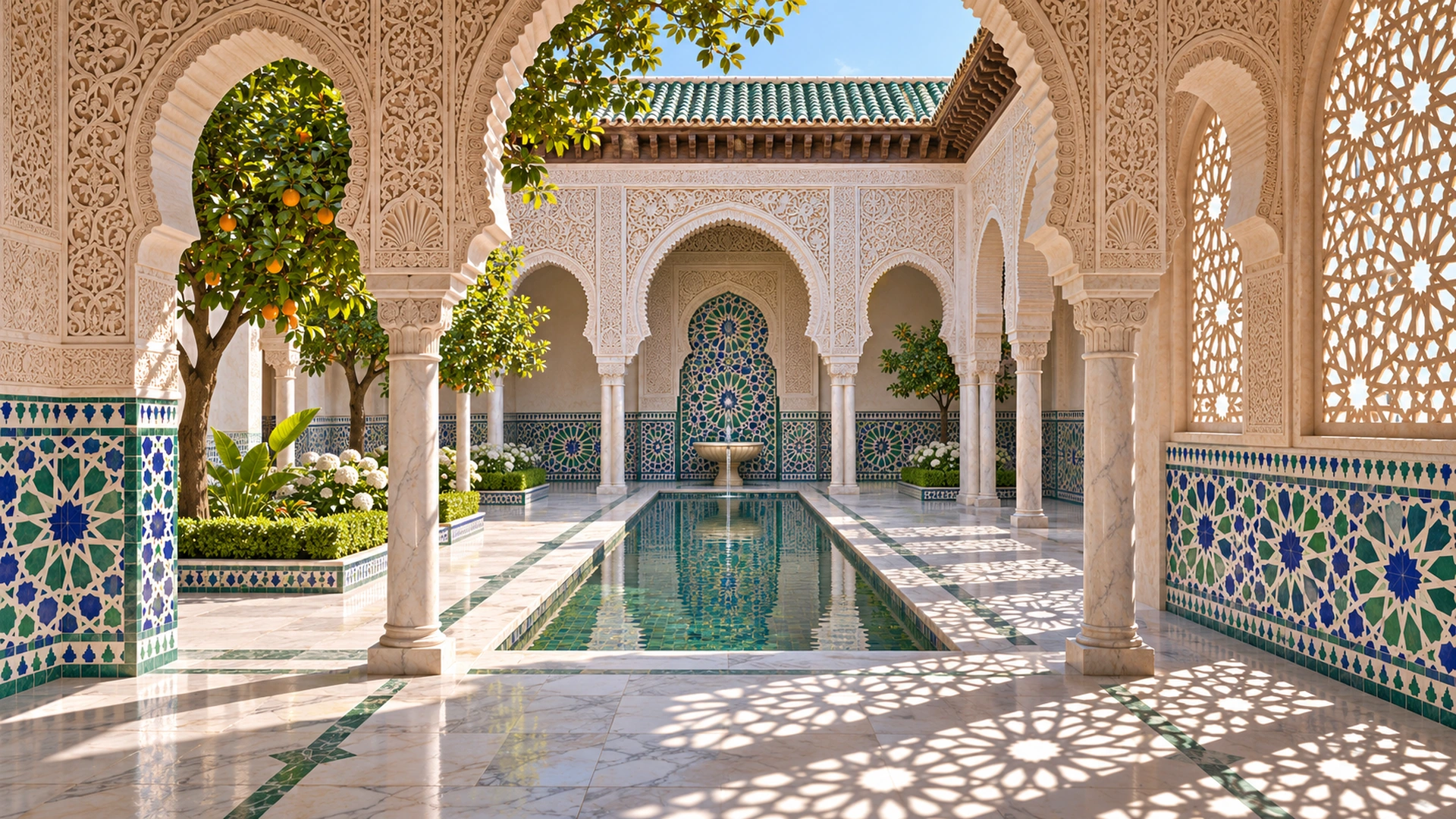
Geometry, water and light
Islamic architecture is not one style but many regional traditions shaped by shared ideas. From the Dome of the Rock in Jerusalem (completed 691) and the Great Mosque of Córdoba (begun 785), through the Alhambra in Granada, Seljuk caravanserais, Mimar Sinan's Ottoman mosques in Istanbul and the Mughal Taj Mahal in Agra (1632–1653), builders adapted local materials and earlier Roman, Byzantine and Persian forms.
Common threads include the courtyard as a centre of life, gardens and water channels, domes and arches, and ornament built from geometry, plant forms and calligraphy rather than figures in religious spaces. Muqarnas, honeycomb-like vaults, turn ceilings into cascades of light and shadow, and pierced screens filter sunlight into patterns. These ideas influence contemporary architects and designers worldwide.
Visual anatomy of Islamic Architecture
Open central spaces with arcades, fountains or pools, shading and cooling the building.
Pointed, horseshoe and multifoil arches; domes on squinches or pendentives.
Honeycomb or stalactite vaults built from many small niches.
Star and polygon patterns in tile, stucco, wood and stone, expanding infinitely.
Pierced stone or wooden screens that filter light and air.
Channels, basins and reflecting pools that double the architecture.
Regional traditions
Horseshoe arches, stucco lace and garden courts; the Alhambra.
Large central domes with cascading half-domes and slender minarets.
White marble, pietra dura inlay, gardens; the Taj Mahal.
Tiled domes and monumental portals, as in Samarkand.
How to recognize Islamic Architecture
- Courtyards with arcades and water.
- Geometric patterns and muqarnas.
- Filtered light through screens and arches.
Where people get it wrong
Islamic architecture is often reduced to 'a dome and minarets' or merged into a generic 'Middle Eastern' look. Each region has its own forms and materials. Name the tradition, the building type and the specific elements, or the model will average them into a fantasy.
Words to describe Islamic Architecture
Precise words for the qualities above. Combine a few of them instead of naming the style or artist alone.
- courtyard with arcades
- muqarnas vault
- geometric star tile pattern
- horseshoe arches
- pierced stone screen
- reflecting pool
- filtered sunlight patterns
- tiled dome
- stucco lacework
- garden water channel
An original architecture study: a quiet arcaded courtyard with horseshoe arches and carved stucco, a long narrow reflecting pool down the centre, geometric star patterns in blue, white and green tile on the lower walls, midday sun casting patterned light through a pierced screen onto the marble floor, no people. No calligraphy, letters or text. Not a copy of any existing building.
What to take from Islamic Architecture today
- Name the region and period.
- Choose specific elements: muqarnas, horseshoe arch, tiled dome, screen.
- Describe the light and the water.
Questions about Islamic Architecture
What is Islamic Architecture?
A thousand years of building from Córdoba to Delhi: courtyards, domes, muqarnas vaults, geometric tilework and light filtered through carved screens.
How do you recognize Islamic Architecture?
Courtyards with arcades and water. Geometric patterns and muqarnas. Filtered light through screens and arches.
How do you describe Islamic Architecture in words or a prompt?
Name the region and period. Choose specific elements: muqarnas, horseshoe arch, tiled dome, screen. Describe the light and the water.
Describe a quiet courtyard in one specific tradition you choose: its arches, the pattern on the walls, the water, and how midday light falls across the floor.