Modernism made friendly
Mid-century modern grew in the United States and Scandinavia after the Second World War, roughly from 1945 to 1970. It took the Bauhaus idea that form follows function and made it warmer and more domestic, using new materials developed in wartime: moulded plywood, fibreglass, bent steel and plastics. The term itself was popularised later, by Cara Greenberg's 1984 book.
Charles and Ray Eames designed moulded plywood and fibreglass chairs and the 1956 lounge chair; Eero Saarinen made the Tulip chair and soaring airport terminals; Arne Jacobsen and Hans Wegner defined Danish modern. In California the Case Study Houses opened living rooms to gardens through walls of glass. In graphics, Saul Bass, Paul Rand and Alvin Lustig reduced ideas to bold shapes. The style returned strongly after 2000 and is now a default for interiors, branding and illustration.
Visual anatomy of Mid-Century Modern
Clean, simple lines with gentle organic curves.
Slim tapered or hairpin legs lifting furniture off the floor.
Teak, walnut, moulded plywood, fibreglass, steel, glass.
Warm wood with mustard, olive, teal, burnt orange and off-white.
Open plans, big windows, indoors flowing into outdoors.
Flat geometric shapes, boomerangs, starbursts, playful sans-serif type.
Key names
Moulded plywood and fibreglass chairs; the Eames Lounge Chair (1956).
The Tulip chair and table; the TWA Flight Center (1962).
The Egg and Swan chairs (1958) and Danish modern interiors.
Experimental Californian houses of steel and glass, 1945–1966.
How to recognize Mid-Century Modern
- Tapered wooden legs and low, clean furniture.
- Warm wood with mustard, teal and orange.
- Large windows and open, uncluttered rooms.
Where people get it wrong
Mid-century modern is often mixed up with Googie and retro kitsch. Googie is loud roadside architecture; mid-century modern at home is calm, crafted and restrained, with quality materials and little ornament.
Words to describe Mid-Century Modern
Precise words for the qualities above. Combine a few of them instead of naming the style or artist alone.
- mid-century modern interior
- tapered wooden legs
- moulded plywood chair
- teak sideboard
- mustard and teal accents
- floor-to-ceiling windows
- hairpin legs
- warm walnut wood
- starburst clock
- clean organic curves
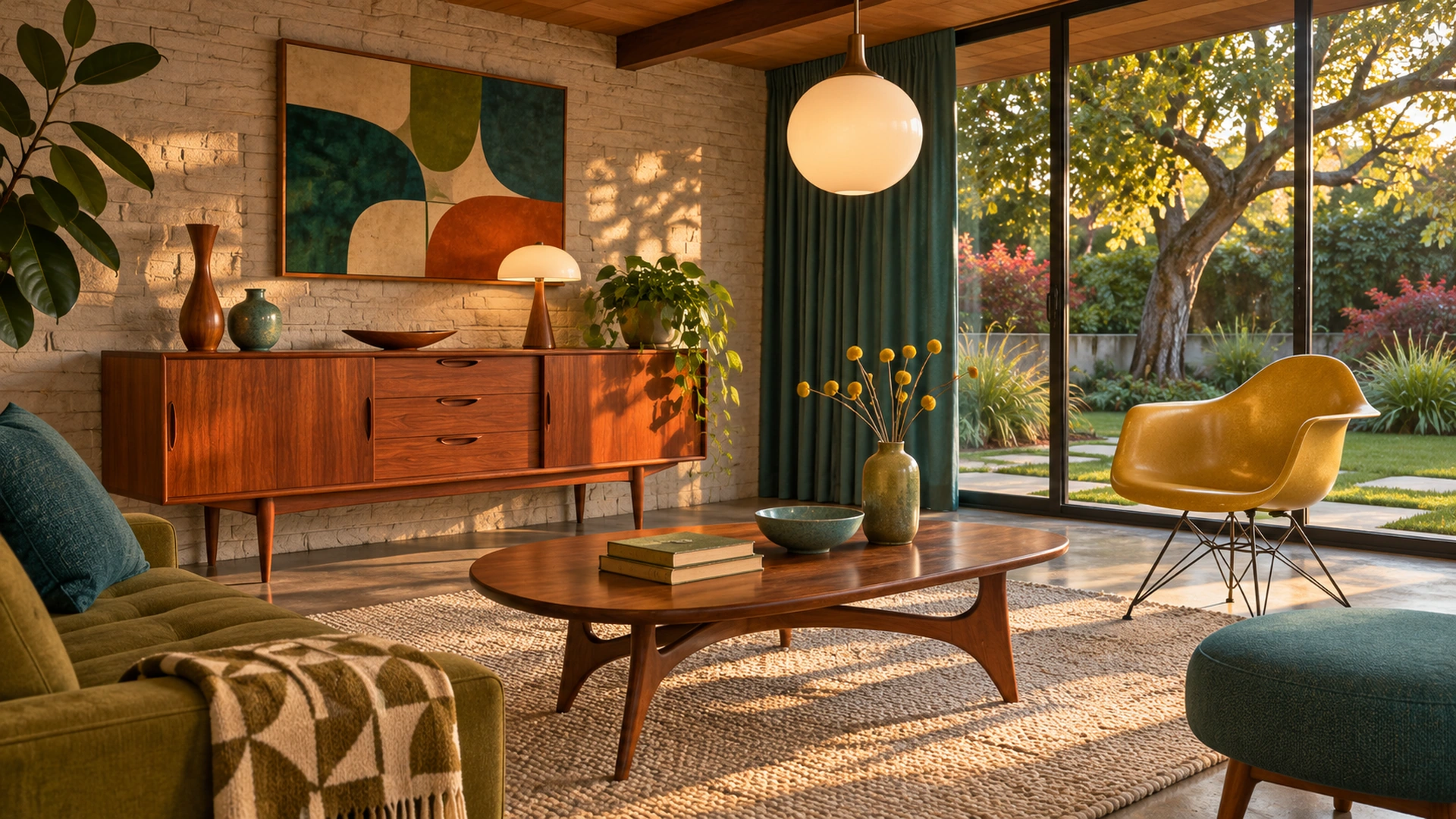
An original mid-century modern interior study: a sunlit living room with a low teak sideboard on tapered legs, a moulded shell chair in mustard, a walnut coffee table, a globe pendant lamp, a floor-to-ceiling window opening onto a garden, olive and teal accents, late afternoon light. No text, no logos.
What to take from Mid-Century Modern today
- Name the furniture forms: tapered legs, moulded shell chair, low sideboard.
- Give the wood and two or three accent colours.
- Describe the light and how indoors meets outdoors.
Questions about Mid-Century Modern
What is Mid-Century Modern?
The post-war look of clean lines and friendly curves: tapered wooden legs, moulded plywood, glass walls, mustard and teal, and graphics full of simple shapes.
How do you recognize Mid-Century Modern?
Tapered wooden legs and low, clean furniture. Warm wood with mustard, teal and orange. Large windows and open, uncluttered rooms.
How do you describe Mid-Century Modern in words or a prompt?
Name the furniture forms: tapered legs, moulded shell chair, low sideboard. Give the wood and two or three accent colours. Describe the light and how indoors meets outdoors.
Describe a reading corner in mid-century modern style: one chair, one lamp, one side table, the wood, two accent colours and the window behind.