Light as material
Stained glass is coloured glass cut into shapes, held together by strips of lead called cames, and set in a window so that daylight passes through. Details such as faces and folds are painted on the glass in a dark vitreous paint and fired. The craft flourished in medieval Europe: the windows of Chartres Cathedral, made mostly in the early thirteenth century, and the Sainte-Chapelle in Paris (consecrated 1248) turned church walls into walls of coloured light.
Gothic architecture made this possible, because its ribbed vaults and flying buttresses carried the weight of the roof and freed the walls for glass. The craft declined and returned: the Gothic Revival brought it back in the nineteenth century, and Louis Comfort Tiffany in New York developed opalescent glass and the copper-foil technique, which made the curving lampshades of the 1890s and 1900s possible. Art Nouveau used leaded glass in doors and windows; later artists such as Marc Chagall designed modern windows for cathedrals and synagogues.
Visual anatomy of stained glass
Pot-metal glass coloured throughout; flashed glass with a thin coloured layer.
Dark cames outlining every piece; they are part of the drawing.
Dark grisaille lines and shading for faces, hands and folds.
Transmitted light: colour glows when backlit and changes with the sun.
Saturated jewel tones: ruby, cobalt, emerald, amber; Gothic blue.
Medallions, tracery and borders; rose windows radiating from a centre.
Terms
H-shaped lead strip that holds the pieces.
Grey-brown glass paint for line and shade; also windows in mostly grey glass.
A large circular window with radiating tracery, typical of Gothic cathedrals.
Stone ribs dividing a window into shapes.
Tiffany's technique of wrapping each piece in foil and soldering, for fine curves.
Milky, streaked glass developed by Tiffany and John La Farge.
How to recognize stained glass
- Dark lines around every coloured shape.
- Colour that glows as if lit from behind.
- Saturated jewel colours.
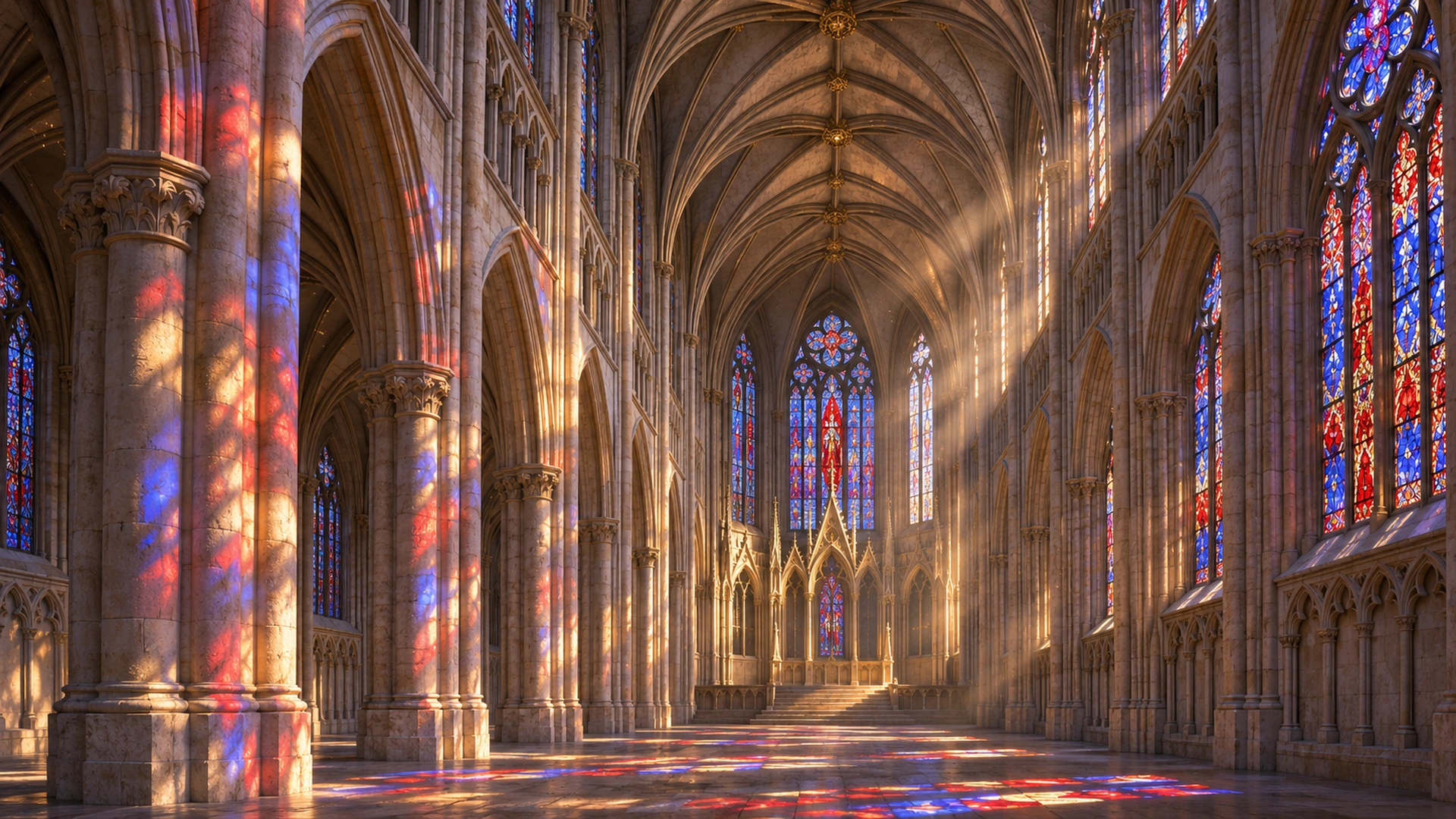
- Coloured light falling on the floor or wall nearby.
Where people get it wrong
Drawing stained glass as a flat cartoon with black outlines. Its life comes from light passing through: uneven glass with streaks and bubbles, colour that glows brighter at the centre, painted shading on faces, and pools of coloured light thrown into the room. Describe the light source and where the coloured light lands.
Words to describe stained glass
Precise words for the qualities above. Combine a few of them instead of naming the style or artist alone.
- stained glass
- lead cames
- jewel-toned glass
- backlit
- rose window
- stone tracery
- grisaille painting
- streaky glass
- copper foil
- opalescent glass
- coloured light pools
- Gothic blue
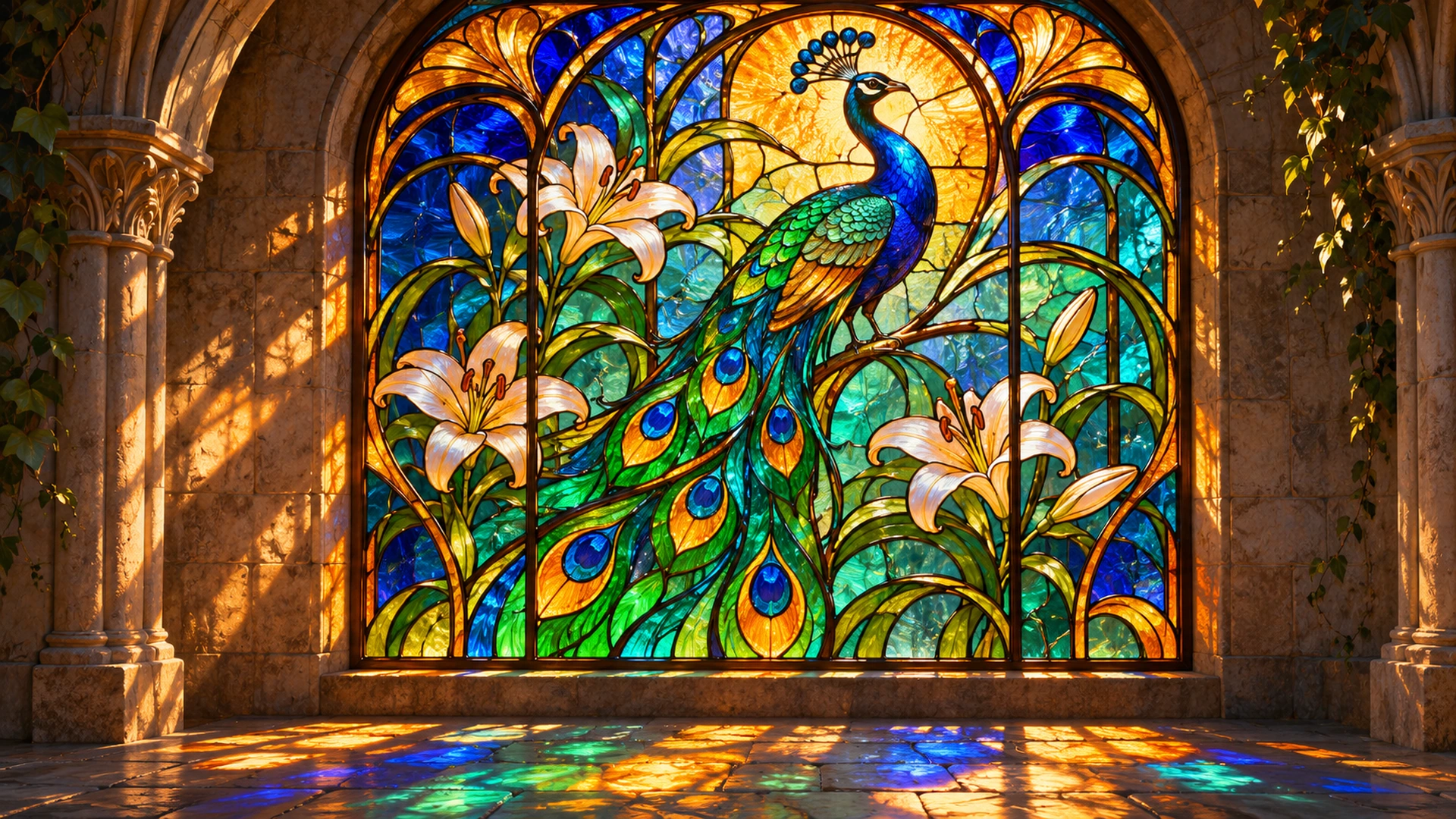
An original stained-glass study: a tall arched window of a peacock among lilies in Art Nouveau curves, deep cobalt, emerald and amber glass held in dark lead lines, streaks and small bubbles in the glass, late sun shining through and throwing patches of coloured light across a stone floor.
What to take from stained glass today
- Say it is backlit by daylight or sun.
- Describe the lead lines and painted detail.
- Name the glass: streaky, bubbled, opalescent, flashed ruby.
- Add the coloured light falling on stone or skin.
Questions about stained glass
How is stained glass made?
Coloured glass is cut to a pattern, details are painted on with dark glass paint and fired, and the pieces are joined with lead cames or copper foil and soldered.
Why are Gothic cathedrals full of stained glass?
Ribbed vaults and flying buttresses carried the roof's weight, so walls could be opened into huge windows filled with glass.
Find a photograph of a stained-glass window with sunlight coming through. Describe it twice: once as an object (glass, lead, paint) and once as light (what colour lands where in the room).
Sources and further reading
- Virginia Chieffo Raguin, Stained Glass: From Its Origins to the Present (2003).
- Sarah Brown, Stained Glass: An Illustrated History (1992).